[VT | July 2, 2026 | Philadelphia PA]
On the 250th anniversary of the Continental Congress’ vote for American independence, more than 70 bipartisan mayors from across the United States gathered in Philadelphia for the historic March of America’s Mayors, reaffirming the role of local leadership in strengthening American democracy and looking ahead to the nation’s next 250 years.
Hosted by the City of Philadelphia in partnership with the United States Conference of Mayors, the National Constitution Center, the Pennsylvania Municipal League, and the Museum of the American Revolution, the gathering brought together mayors from communities large and small to commemorate one of the most consequential moments in American history on the very ground where it took place.
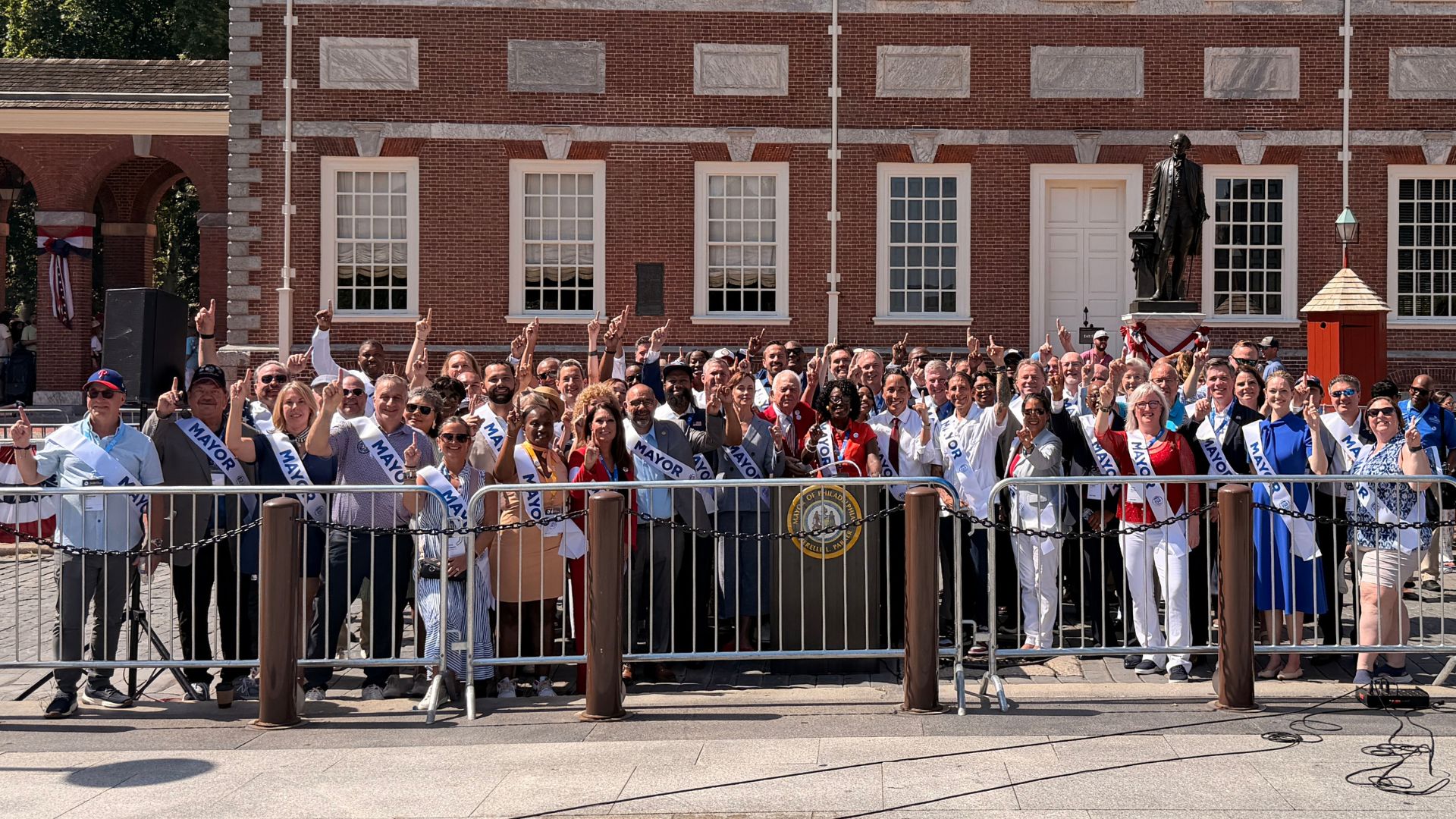
Beginning near the President’s House site, participants marched through Philadelphia’s Historic District to Independence Hall, where they paused for a commemorative photograph before continuing to the Museum of the American Revolution for “We the People: The Mayoral Vision for America’s Future,” a bipartisan symposium exploring democracy, civic leadership, and the role of America’s cities in the country’s next chapter.
Although Independence Day is celebrated on July 4, it was July 2, 1776, that the Continental Congress voted for independence. Two days later, delegates approved the final text of the Declaration of Independence. The gathering intentionally took place on the anniversary of the vote itself, connecting today’s city leaders with the moment America’s path toward independence formally began.
Walking Through American History
The morning began near the President’s House site on Market Street, where mayors representing communities large and small assembled before walking together through Independence National Historical Park.
The route itself carried symbolic meaning.
Participants passed the site of the nation’s first executive mansion, continued to Independence Hall—where the vote for independence took place—and paused for an official photograph before proceeding to the Museum of the American Revolution for a symposium examining democracy, constitutional government, and the future of American cities.
Rather than emphasizing partisan politics, organizers described the gathering as a reminder that mayors remain the elected officials closest to the people they serve.
Across the country, city leaders confront many of the nation’s most immediate challenges—from public safety and housing affordability to infrastructure, economic opportunity, neighborhood revitalization, public health, and quality-of-life services.
Philadelphia at the Center of America’s 250th Anniversary
As host city, Cherelle L. Parker framed the gathering as both a historic commemoration and a call for civic unity.
In her official remarks, Parker said that while America’s mayors represent different political parties and different communities, they share a common responsibility: serving people and solving problems.
“At a time when so much in our country can pull people apart, mayors still have a responsibility to bring people together.”
Her message centered on a theme repeated throughout the day:
“One America, A United Nation.”
Following the symposium, Mayor Parker spoke exclusively with ChineseInUS, describing the event as unlike any other mayoral gathering.
“This was a historic convening by the U.S. Conference of Mayors. They convened mayors from across America, representing rural, suburban, and urban America—from every political persuasion you can think of.”
She emphasized that what united participants was not ideology but public service.
“Today they convened in Philadelphia under the guise of us being mayors and being doers—the fixers of America.”
Parker said the conversations left her inspired.
“They reminded me that when we say One Philly, a United City, and One America, a United Nation, it is because we can become a more perfect union together—for everyone.”
A Bipartisan Vision for America’s Cities
The symposium brought together mayors, historians, constitutional scholars, educators, business leaders, and civic organizations to discuss the role local government will play during America’s next chapter.
Todd Gloria, President of the U.S. Conference of Mayors, acknowledged that democracy today faces growing challenges, including declining trust in institutions and increasing political polarization.
Yet he argued that American history demonstrates continuous progress rather than perfection.
“Ours has never been a perfect union. We have always been a nation striving to become a more perfect one.”
His remarks reflected one of the day’s recurring themes: while national politics often dominate public attention, America’s cities continue doing the practical work of governing every day.
The symposium’s keynote address was delivered by Akhil Reed Amar, Sterling Professor of Law and Political Science at Yale University and one of the nation’s foremost constitutional scholars. Amar examined how the founding principles of the Declaration of Independence and the Constitution continue to shape American democracy 250 years later.
Exclusive | Steve Benjamin: “We Are a Nation of Immigrants”
Among those attending the gathering was Stephen K. Benjamin, former Mayor of Columbia, South Carolina, former President of the U.S. Conference of Mayors, and former Director of the White House Office of Public Engagement.
Speaking exclusively with ChineseInUS, Benjamin described the gathering as deeply personal.
“We’re celebrating the Semiquincentennial on the day it actually happened—July 2, 1776.”
He called America “the greatest experiment in democracy in the history of the world,” adding that the country’s history has always been one of striving toward improvement rather than claiming perfection.
He praised Mayor Parker for bringing together Republican, Democratic, and independent mayors to celebrate the founding ideals expressed in the opening lines of the Declaration of Independence.
“It’s important to commemorate our progress and think about the role we can play in continuing to develop this country over the next 250 years.”
Language Access and the Future of Civic Participation
While many discussions throughout the day focused on democracy, constitutional history, and local leadership, ChineseInUS asked Benjamin about an issue rarely addressed during America250 commemorations: language access.
His answer connected America’s founding story with its immigrant future.
“We often forget that we are a nation of immigrants.”
Benjamin noted that people from every continent have contributed to America’s development over the past 250 years.
“If we’re going to live up to our true and full potential, we need to make sure that language access and fully integrating everyone into society become central and core to who we are.”
Drawing from his experience as mayor of Columbia, he recalled that residents spoke approximately 80 different languages, requiring city government to actively ensure services remained accessible.
“We need to meet people where they are so they can fully participate in the benefits of this country.”
He concluded with a broader vision for America’s future:
“If we actually leverage all of our strengths, it makes us a better, healthier, and stronger nation.”
Beyond Commemoration
For many attendees, July 2 was about honoring the nation’s founding.
But throughout the day’s march, symposium, and conversations, another message emerged.
America’s next 250 years will not be defined solely by the ideals written in 1776, but by how those ideals continue to expand—through local leadership, civic participation, and ensuring that every community, regardless of language or background, has the opportunity to help shape the country’s future.