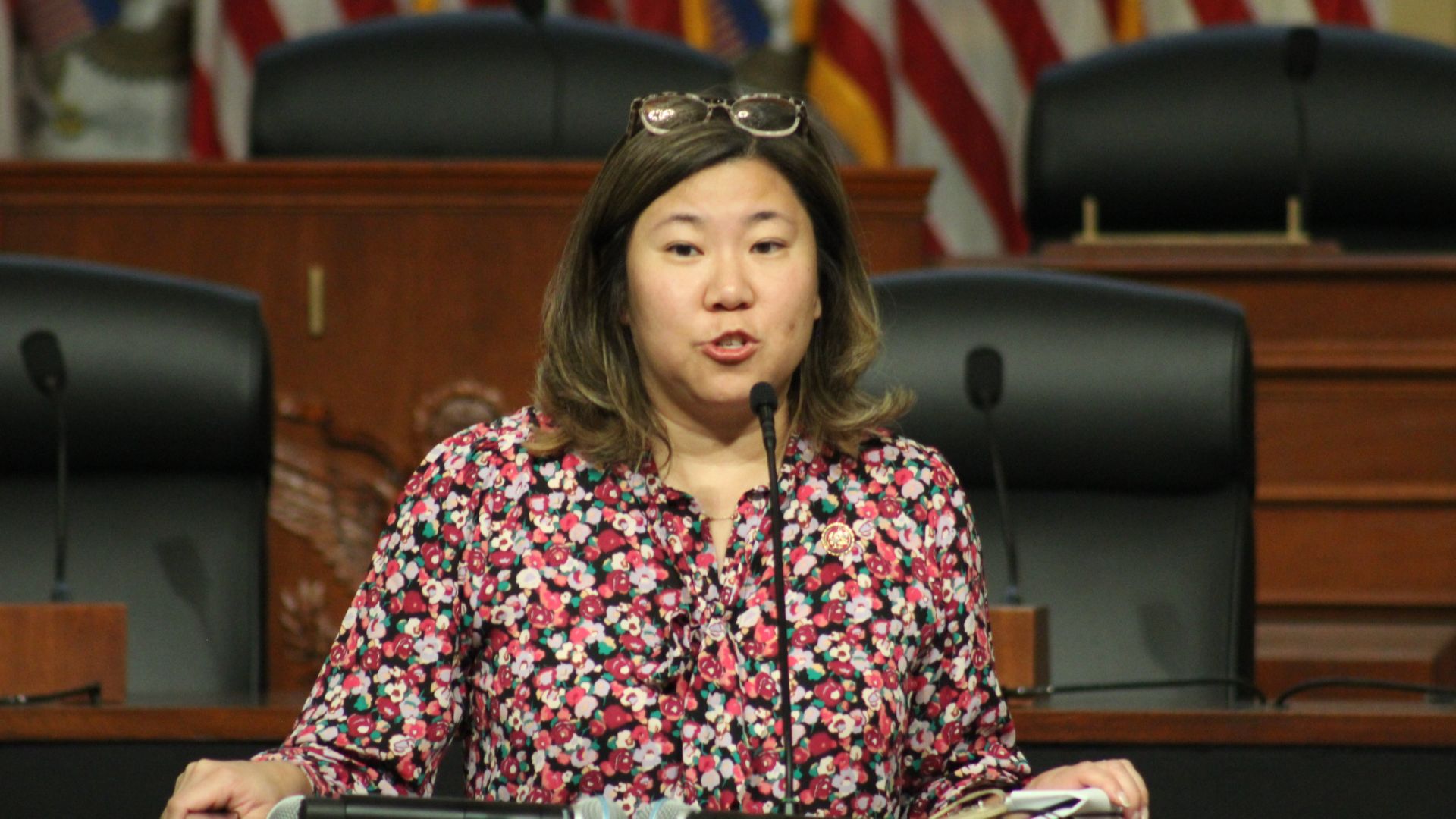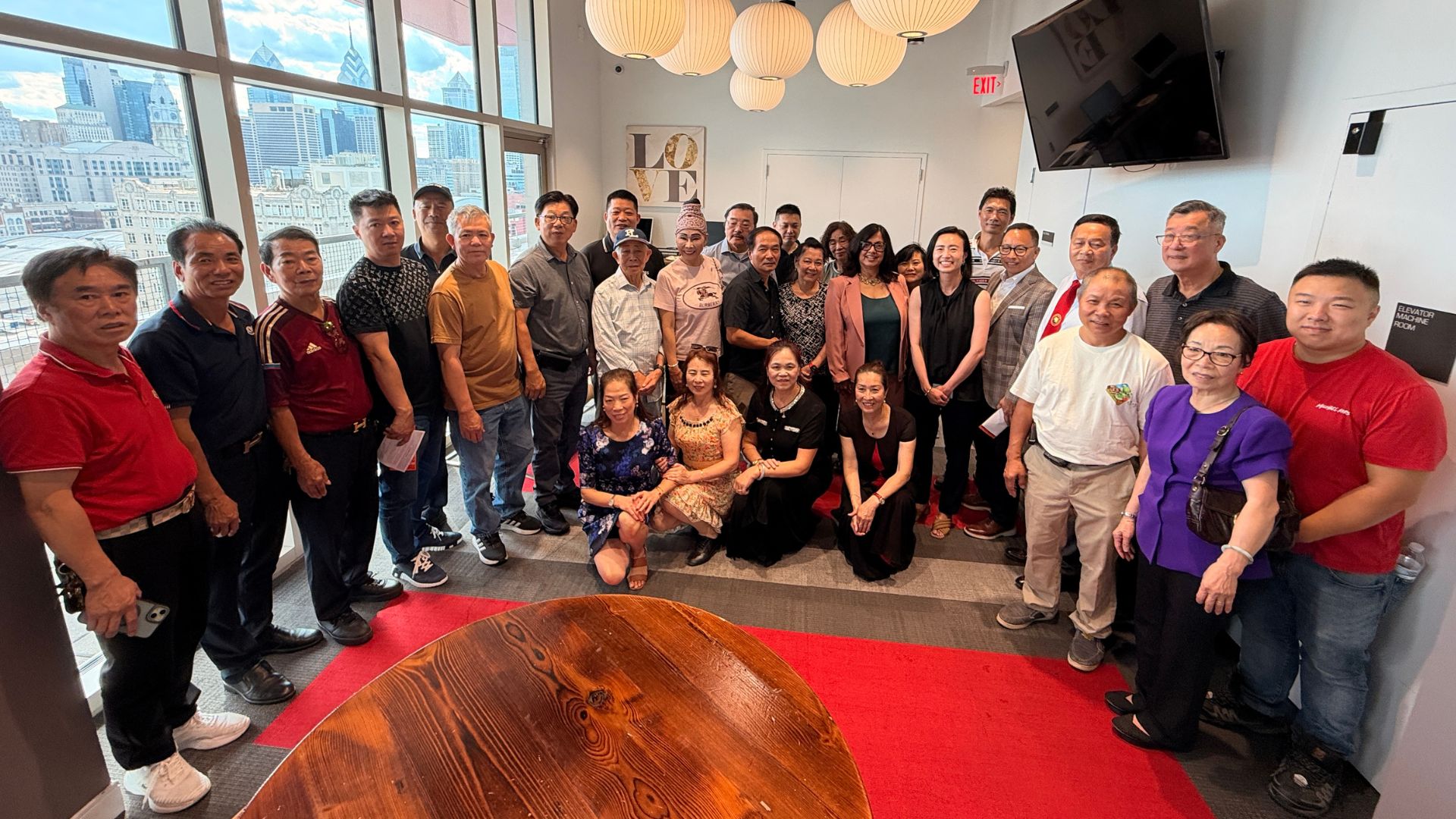
A San Francisco supervisor running for Nancy Pelosi’s seat came to Philadelphia’s Chinatown a week before the Mid-Autumn Festival. In an exclusive interview with VisibleTogether, she laid out what she would bring back from Washington.
[VT | October 30, 2026 | Philadelphia, PA]
On Sept. 18, San Francisco Supervisor Connie Chan, a Democrat running for California’s 11th Congressional District, made several stops in Philadelphia’s Chinatown, including a fundraiser for her campaign held at the Gee How Oak Tin Association, and sat down with VisibleTogether for an exclusive interview before catching a train to New York that evening.
The visit drew officers of several of the city’s oldest Chinese community associations and an at-large member of Philadelphia City Council. It also offered a view of why a House race on the West Coast matters across the country.
First, the ancestral hall
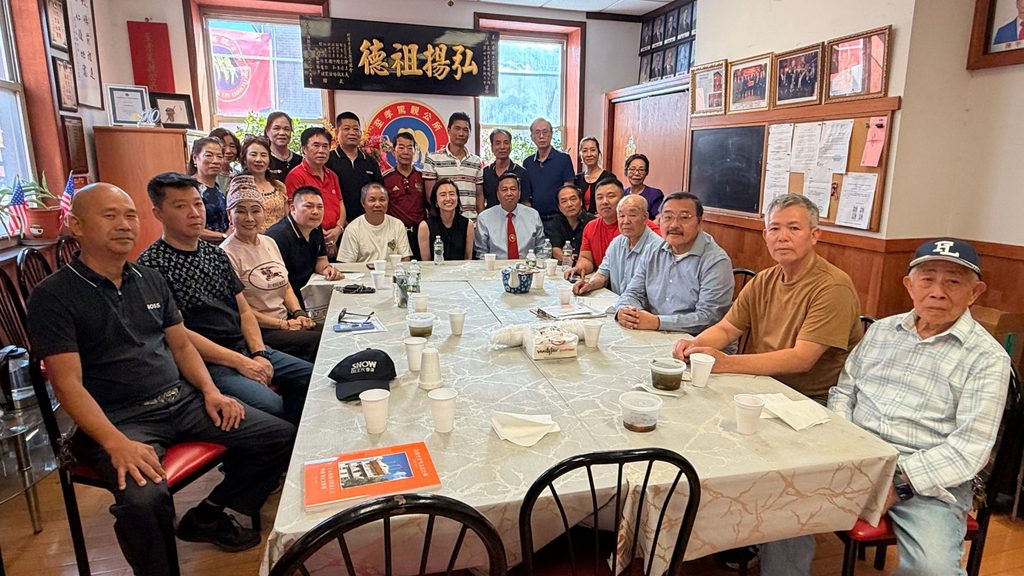
Chan’s first stop was the Gee How Oak Tin Association, a family association uniting the Chan, Woo and Yuen surnames. Chan told the gathering that relatives in San Francisco had urged her, once they heard she was coming east, to be sure to visit the Philadelphia hall.
The community meeting
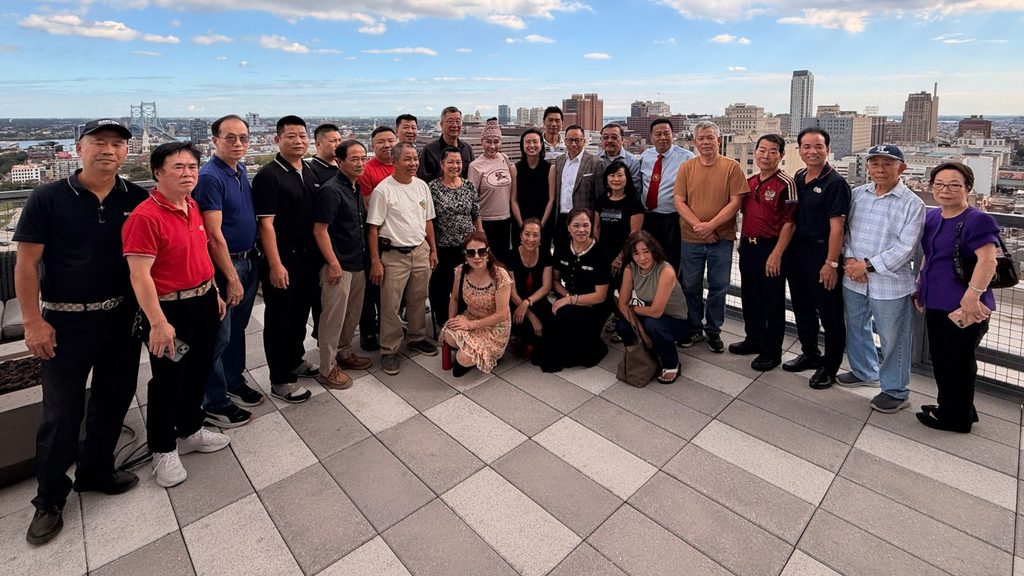
The community meeting
Her next stop was a community meeting in the Crane building, where leaders of the Tsung Tsin Association, the Shenzhen chamber of commerce for the Eastern U.S., a Guangdong regional association and a Chinese women’s association joined her.
John Chin, PCDC’s executive director and himself a member of Gee How Oak Tin, noted that Philadelphia’s Chinatown, like San Francisco’s, has received generation after generation of immigrants for well over a century.
Connie Chan spoke in Cantonese. When Pelosi first ran for Congress, she said, her first campaign event was held in San Francisco’s Chinatown. Yet in more than 170 years, the city’s Chinese community has never sent one of its own to Congress. She said she hoped to represent “not only the Chinese of San Francisco” but Chinese communities nationwide, and to keep bringing investment back to them.
Philadelphia City Council Member At-Large Nina Ahmad also attended and spoke. She said Philadelphia needs to know which committee the next member of Congress will sit on, because federal cuts to SNAP and Medicaid are coming: “Our people are going to hurt, and a lot of our seniors in the Asian community are going to hurt.”
About Connie Chan
Chan was elected to the San Francisco Board of Supervisors in 2020 and re-elected in 2024. The seat she is seeking has been held by former House Speaker Nancy Pelosi since 1987; Pelosi has endorsed her. If elected, Chan would be the first Chinese American to represent San Francisco in Congress. On Nov. 3 she faces state Sen. Scott Wiener, who has served in the California Legislature since 2016.
VT exclusive interview with Connie Chan: ‘Resources and funding that we can bring back’
In an exclusive interview with VisibleTogether, Chan started from her record at City Hall. She has chaired the Board of Supervisors’ budget committee for the past four years, and she said that job is what she would take to Washington: “Managing a $17 billion budget in San Francisco really helped me understand what we need to do and make sure that the federal government’s budget also reflect our values and serve our community.”
Asked about language access, she said new immigrants often struggle “to really get into the community and also getting services, effective services, from our city government.” That is why she backed requiring San Francisco to serve residents in Chinese and Spanish as well as English. “For that very same approach I will bring it to Congress,” she said, so that when federal agencies offer services and grant opportunities, the information is “not only coming in English” but “multilingual, inclusive of Chinese and Spanish.”
Asked what Asian American communities lack, she said:
“When we want to make sure that our government services reflect our population, we see that it lacks data, it lacks media coverage, it lacks a lot of other information that actually serve our community. And what that means and what we have to do is to organize… This is what happened when community organized and gain power and elect people that can represent us, so that we can actually have media coverage, we can have data in the government, and most importantly resources and funding that we can bring back.”
She said her reach would not stop at her district line: “It is my commitment to not only serve Chinese Americans and Asian Americans in San Francisco and then California. I really wanted to meet more Asian American and Chinese American across the country, including today in Philadelphia, and making sure that we bring that resources and support to Chinese American community across the nation.”
In Congress, she said, she would fight for health care, affordable child care, “fully funded K–12 classrooms” and “meaningful immigration reform” with “a pathway to citizenship.”
With the Mid-Autumn Festival a week away, she closed the interview by wishing Chinese American families a happy holiday in Mandarin, Cantonese and English.
Why it matters beyond San Francisco: a voice is not enough without votes
A city council member shapes city policy; a state legislator, state law. A member of Congress votes on federal law and the federal budget — decisions that reach every city as surely as San Francisco.
But in Congress, a voice is not enough. A bill needs a majority in the House and passage in the Senate. An appropriation needs allies on the committee that writes it. One or two members cannot move national policy alone.
That is why Asian American members organize. The Congressional Asian Pacific American Caucus (CAPAC), chaired by Rep. Grace Meng, has about 80 members and works with the Congressional Black and Hispanic caucuses as the Tri-Caucus.
Many of its leaders have lined up behind Chan. ASPIRE PAC, founded by Asian American members of Congress, endorsed her in November 2025. Its founder, Rep. Judy Chu, the first Chinese American woman elected to Congress; former ASPIRE chair Meng, who is also the top Democrat on the House Appropriations subcommittee on Commerce, Justice and Science; and current ASPIRE chair Rep. Marilyn Strickland have each endorsed her, as have Reps. Pramila Jayapal, Ro Khanna and Jill Tokuda, Rep. Derek Tran and former Rep. Mike Honda.
Philadelphia’s Chinatown Stitch offers one example of how those decisions reach local neighborhoods. The project, a plan to cap the Vine Street Expressway and reconnect the neighborhood, won $158.9 million in federal funding in 2024. In 2025, Congress rescinded all but about $8 million. “We were so excited” when the money came, John Chin, executive director of the Philadelphia Chinatown Development Corp., told VisibleTogether, and when it disappeared, “we felt so sad.”
That is why a congressional race in San Francisco matters far beyond San Francisco, and why communities everywhere have reason to follow Congress as closely as City Hall.