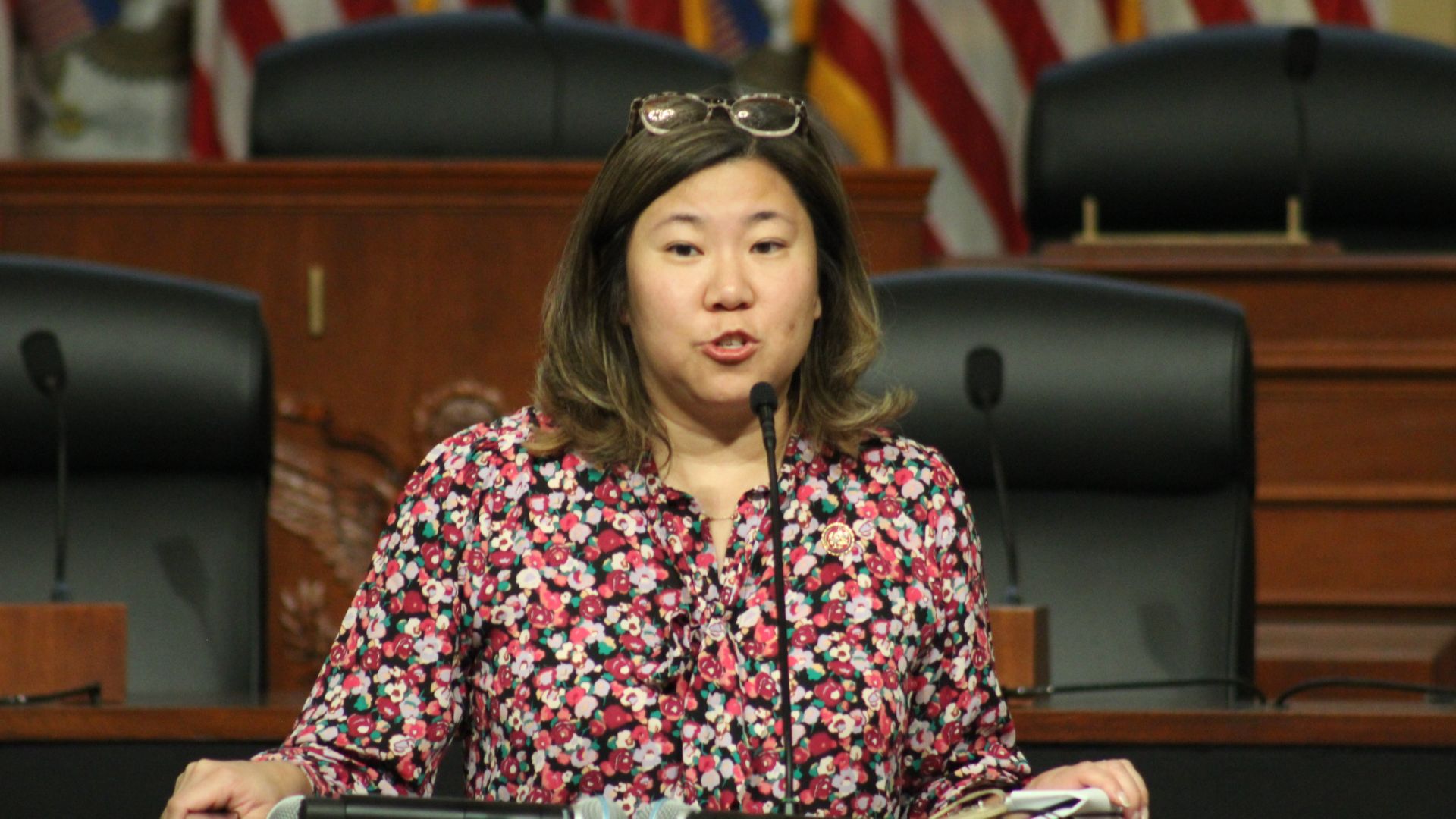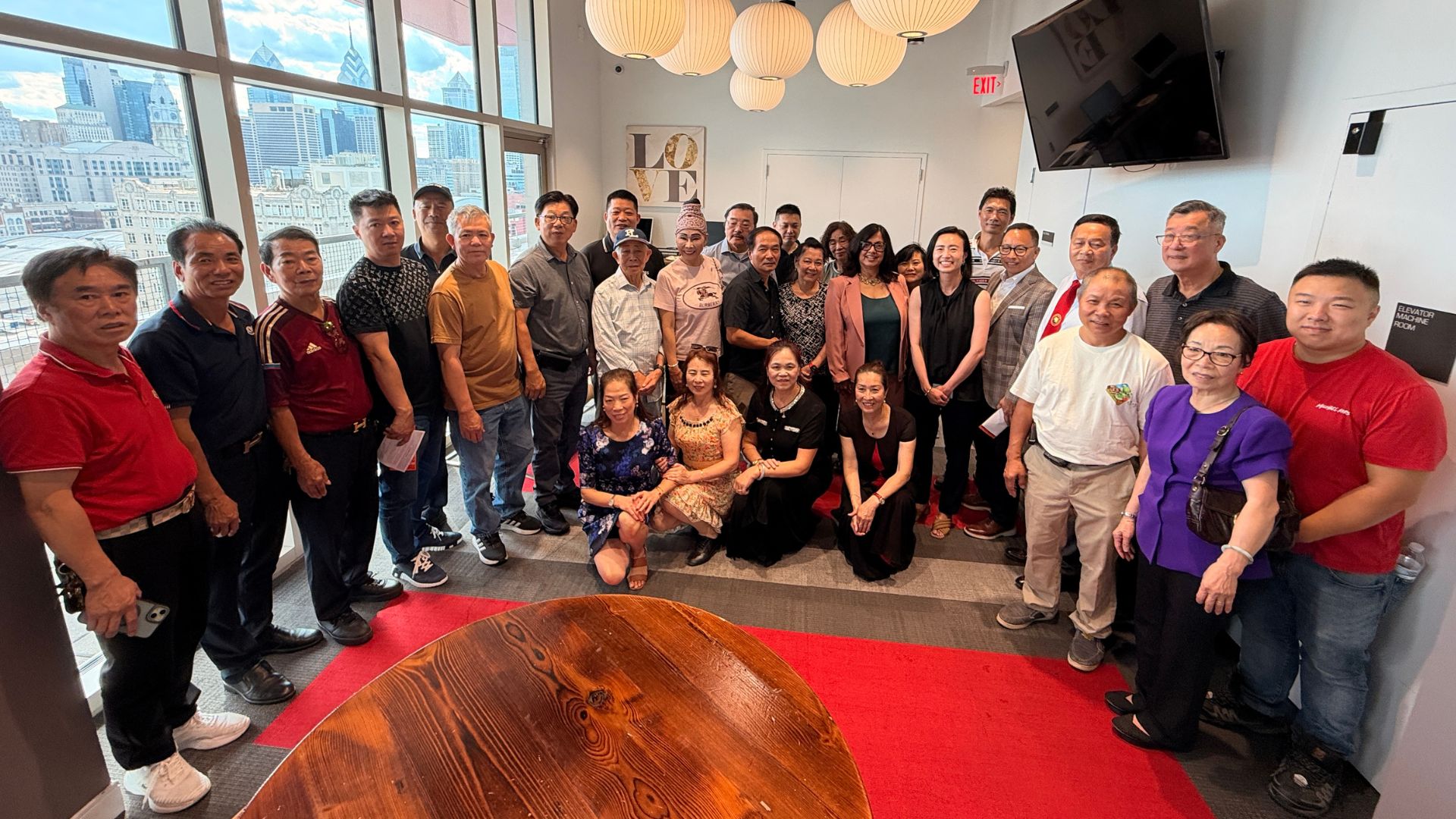
A San Francisco supervisor running for Nancy Pelosi’s seat came to Philadelphia’s Chinatown a week before the Mid-Autumn Festival. In an exclusive interview with VisibleTogether, she laid out what she would bring back from Washington.
[VT | October 30, 2026 | Philadelphia, PA]
On Sept. 18, San Francisco Supervisor Connie Chan, a Democrat running for California’s 11th Congressional District, stopped in Philadelphia’s Chinatown for a campaign fundraiser at the Gee How Oak Tin Association and sat down with VisibleTogether for an exclusive interview before catching a train to New York that evening.
The visit drew officers of several of the city’s oldest Chinese community associations and an at-large member of Philadelphia City Council. It also offered a view of why a House race on the West Coast matters across the country: in Congress, the communities that win federal resources are the ones with members, and votes, in the room.
First, the ancestral hall
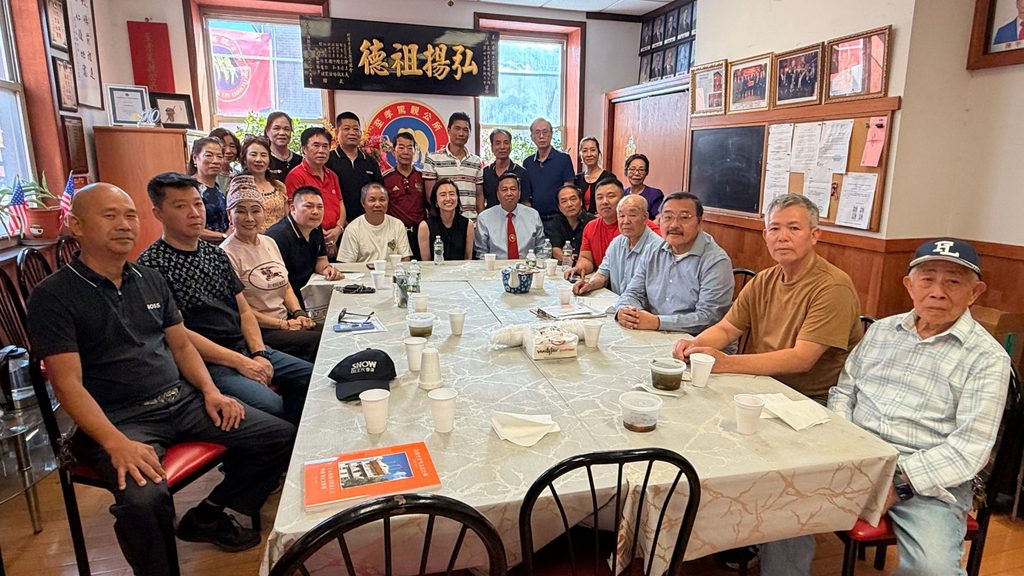
Chan’s first stop was the Gee How Oak Tin Association, a family association that unites the Chan, Woo and Yuen surnames, which by tradition trace their lineage to the legendary Emperor Shun. Branches operate in Chinatowns across North America. Chan told the gathering that relatives in San Francisco had urged her, once they heard she was coming east, to be sure to visit the Philadelphia hall.
She lit incense before the ancestral altar alongside the association’s two chairs, its elders and advisers. Officers of the Chinese Benevolent Association of Philadelphia and the Hip Sing Association joined them. (A full list of attendees appears in ChineseinUS’s Chinese-language report.)
The community meeting
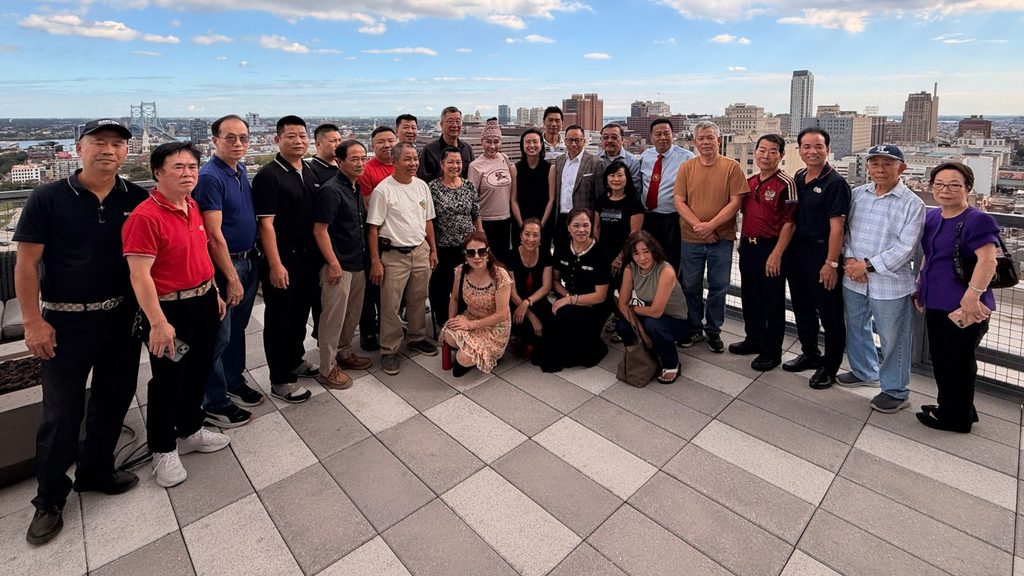
The group then moved to the Philadelphia Chinatown Development Corp.’s community center in the Crane building, where leaders of the Tsung Tsin Association, the Shenzhen chamber of commerce for the Eastern U.S., a Guangdong regional association and a Chinese women’s association joined them.
John Chin, PCDC’s executive director and himself a member of Gee How Oak Tin, opened the meeting by noting that Philadelphia’s Chinatown, like San Francisco’s, has received generation after generation of immigrants for well over a century.
Connie Chan spoke in Cantonese. When Pelosi first ran for Congress, she said, her first campaign event was held in San Francisco’s Chinatown. Yet in more than 170 years, the city’s Chinese community has never sent one of its own to Congress. She said she hoped to represent “not only the Chinese of San Francisco” but Chinese communities nationwide, and to keep bringing investment back to them.
Philadelphia City Council Member At-Large Nina Ahmad also attended and spoke. She said Philadelphia needs to know which committee the next member of Congress will sit on, because federal cuts to SNAP and Medicaid are coming: “Our people are going to hurt, and a lot of our seniors in the Asian community are going to hurt.”
About Connie Chan
Chan was elected to the San Francisco Board of Supervisors in 2020 and re-elected in 2024. The seat she is seeking has been held by former House Speaker Nancy Pelosi since 1987; Pelosi has endorsed her. If elected, Chan would be the first Chinese American to represent San Francisco in Congress. On Nov. 3 she faces state Sen. Scott Wiener, who has served in the California Legislature since 2016.
VT exclusive interview with Connie Chan: ‘Resources and funding that we can bring back’
In an exclusive interview with VisibleTogether, Chan started from her record at City Hall. She has chaired the Board of Supervisors’ budget committee for the past four years, and she said that job is what she would take to Washington: “Managing a $17 billion budget in San Francisco really helped me understand what we need to do and make sure that the federal government’s budget also reflect our values and serve our community.”
Asked about language access, she said new immigrants often struggle “to really get into the community and also getting services, effective services, from our city government.” That is why she backed requiring San Francisco to serve residents in Chinese and Spanish as well as English. “For that very same approach I will bring it to Congress,” she said, so that when federal agencies offer services and grant opportunities, the information is “not only coming in English” but “multilingual, inclusive of Chinese and Spanish.”
Asked what Asian American communities lack, she said:
“When we want to make sure that our government services reflect our population, we see that it lacks data, it lacks media coverage, it lacks a lot of other information that actually serve our community. And what that means and what we have to do is to organize… This is what happened when community organized and gain power and elect people that can represent us, so that we can actually have media coverage, we can have data in the government, and most importantly resources and funding that we can bring back.”
She said her reach would not stop at her district line: “It is my commitment to not only serve Chinese Americans and Asian Americans in San Francisco and then California. I really wanted to meet more Asian American and Chinese American across the country, including today in Philadelphia, and making sure that we bring that resources and support to Chinese American community across the nation.”
In Congress, she said, she would fight for health care, affordable child care, “fully funded K–12 classrooms” and “meaningful immigration reform” with “a pathway to citizenship.”
With the Mid-Autumn Festival a week away, she closed the interview by wishing Chinese American families a happy holiday in Mandarin, Cantonese and English.
Why Philadelphia cares: a voice is not enough without votes
A city council member shapes city policy; a state legislator, state law. A member of Congress votes on federal law and the federal budget — decisions that reach Philadelphia as surely as San Francisco.
But in Congress, a voice is not enough. A bill needs a majority in the House and passage in the Senate. An appropriation needs allies on the committee that writes it. One or two members cannot move national policy alone.
That is why Asian American members organize. The Congressional Asian Pacific American Caucus (CAPAC), chaired by Rep. Grace Meng, has 79 members in the current Congress and works with the Congressional Black and Hispanic caucuses as the Tri-Caucus on immigration, civil rights and health care — working to build the votes no single member has.
That network has lined up behind Chan. ASPIRE PAC, founded by Asian American members of Congress, endorsed her in November 2025. Its founder, Rep. Judy Chu, the first Chinese American woman elected to Congress; former ASPIRE chair Meng, who is also the top Democrat on the House Appropriations subcommittee on Commerce, Justice and Science; and current ASPIRE chair Rep. Marilyn Strickland have each endorsed her, as have Reps. Pramila Jayapal, Ro Khanna and Jill Tokuda, Rep. Derek Tran and former Rep. Mike Honda.
One more Chinese American member adds one more vote, and one more voice, to that coalition. The benefit does not stop at San Francisco’s city limits — which is what Chan meant in Philadelphia when she said she would represent “not only the Chinese of San Francisco.”
VT interview with John Chin: money Congress gave, and took back
What does federal policy look like from a single neighborhood? VisibleTogether put that question to John Chin, executive director of the Philadelphia Chinatown Development Corp. Asian Americans are about 7% of the U.S. population, he said, but a far smaller share of government — and representation shapes where government and foundation money goes.
Asked how the community’s relationships with city, state and federal government have changed, John Chin said they are strong at every level: when an organization delivers, officials pay attention and treat it as a partner. But he was blunt about a gap. The community supports candidates at election time, he said, and then too often fails to make sure they come back and deliver once in office — not just at Lunar New Year and Mid-Autumn celebrations, but in working meetings with their staff.
Nothing illustrates the stakes better than the highway over Chinatown’s head.
Interstate 676, the Vine Street Expressway, has cut the neighborhood in two for decades. The Chinatown Stitch, a plan to cap it and reconnect the blocks, won $1.8 million in federal planning money in 2022 and $158.9 million from the Inflation Reduction Act in 2024. In 2025, the budget reconciliation law passed by Congress rescinded all but about $8 million.
“We were so excited” when the money came after decades of waiting, John Chin said, and devastated when it disappeared. “We always had to fight harder than everybody else.” PCDC and its partners have spent the past two years trying to win it back. The regional planning commission and the city have since committed $12.5 million to make the project shovel-ready, but construction dollars will have to come from Congress again.
PCDC’s own funding is stable for now, John Chin said, but federal cuts to housing, social services, Medicaid, Medicare and SNAP are making it harder for community nonprofits to operate.
The lesson for Chinatown is institutional, not partisan: a federal award is not final until the money is spent. What Congress appropriates, Congress can rescind — which is why who sits in the House, and with whom they vote, matters to a neighborhood in Philadelphia.