[VT | August 1, 2026 | Philadelphia PA]
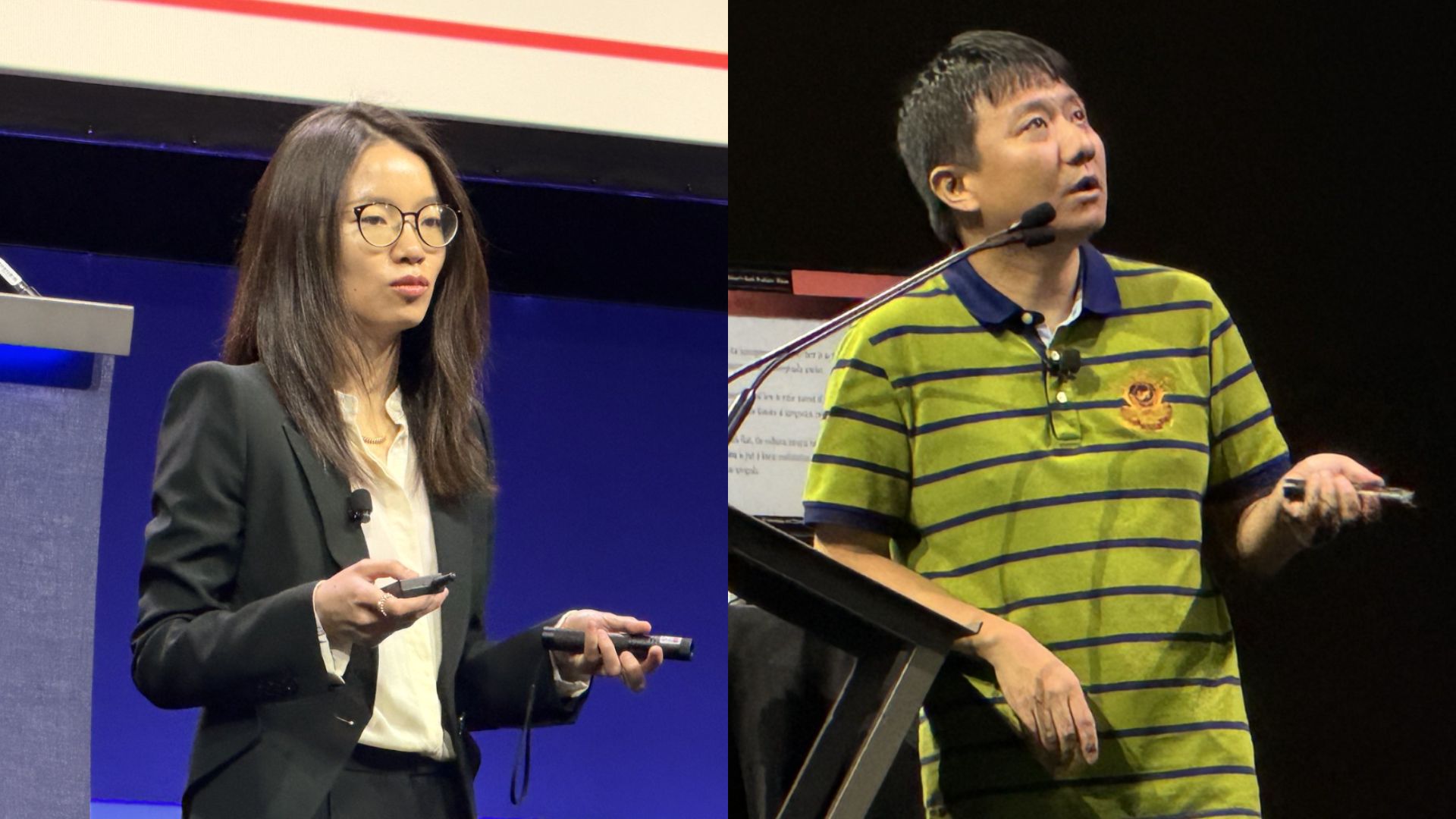
At the opening of the 2026 International Congress of Mathematicians (ICM) in Philadelphia on July 23, International Mathematical Union (IMU) President and 2026 Fields Medal Committee Chair Hiraku Nakajima announced this year’s four Fields Medalists: Hong Wang, Yu Deng, John Pardon and Jacob Tsimerman.
Wang was recognized for breakthroughs in harmonic analysis and geometric measure theory, including work related to Fourier restriction, Furstenberg sets and the three-dimensional Kakeya conjecture. Deng was honored for major advances in partial differential equations, including the rigorous derivation of the Boltzmann equation from hard-sphere dynamics and the derivation of wave kinetic equations from nonlinear dispersive systems.
Wang grew up in Guilin, China, and is now a professor at New York University’s Courant Institute of Mathematical Sciences and a permanent professor at the Institut des Hautes Études Scientifiques in France. Deng grew up in Shenzhen and is now a professor of mathematics at the University of Chicago.
Their reactions to learning they had won were markedly understated.
Deng was reading a novel in January when he received an email from Nakajima asking whether they could arrange a Zoom call. Knowing roughly when previous Fields Medalists had been notified, Deng suspected what the request might mean.
He went back to reading his novel.
Wang received the news about half an hour before she was scheduled to give a mathematics talk. She had to put the award out of her mind and return to preparing for the lecture.
Hong Wang: From a Rotating Needle to the Three-Dimensional Kakeya Conjecture
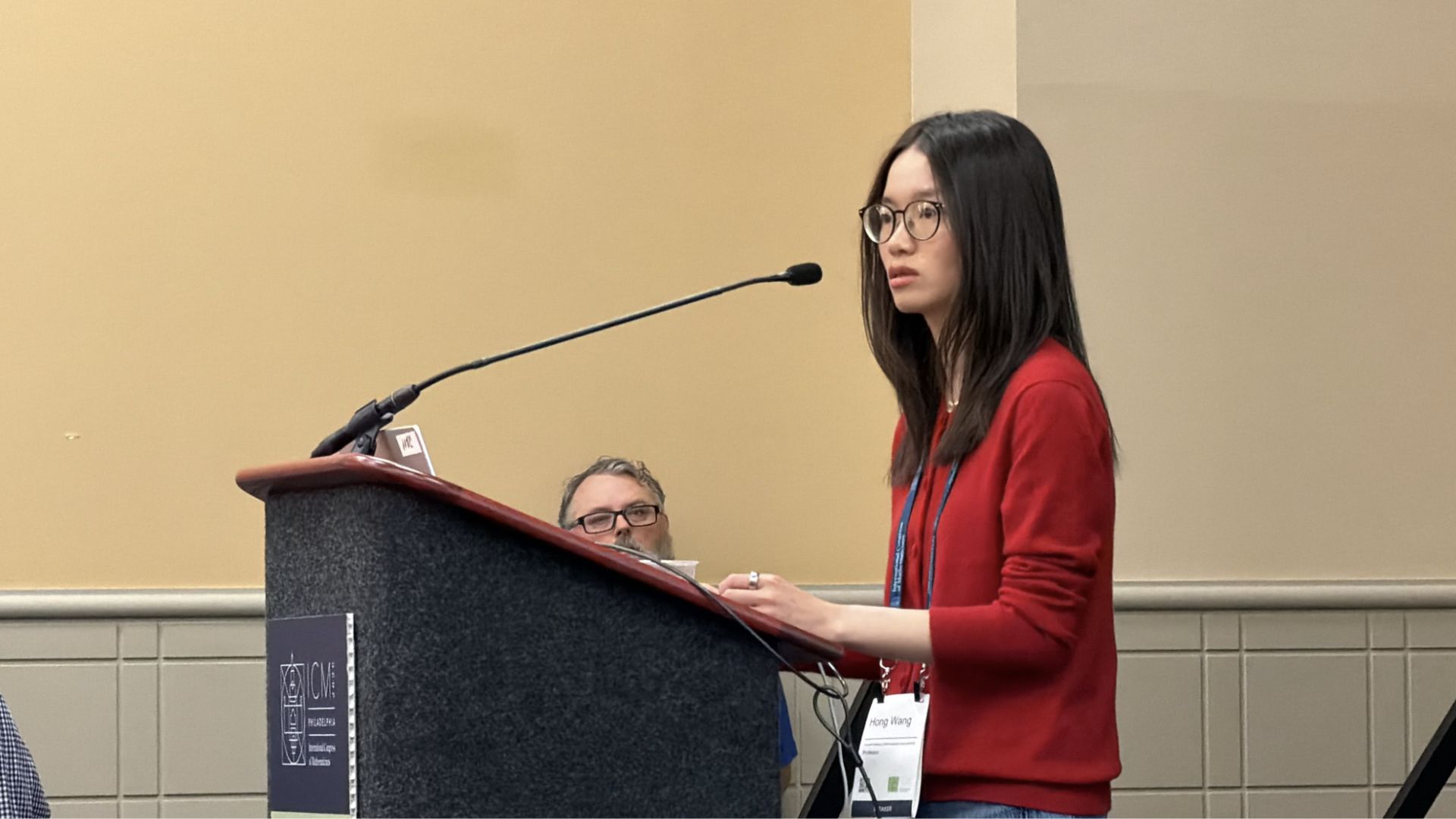
Wang became interested in mathematical problems when she was five or six years old. Her father taught mathematics, and her parents gave her considerable freedom to explore books and problems on her own.
Mathematics became much harder for her in college. At one point, discouraged by the difficulty, she spent time in Paris doing an architecture internship. Afterward, she decided to devote some of her most creative years to mathematics and reconsider after five years if it did not work out.
From then on, she has said, she stopped worrying about whether she was “good at mathematics.”
Wang later completed her doctorate at MIT under mathematician Larry Guth. Her research now focuses primarily on Fourier analysis and geometric measure theory.
One of her best-known achievements, completed with Joshua Zahl, concerns the three-dimensional Kakeya conjecture.
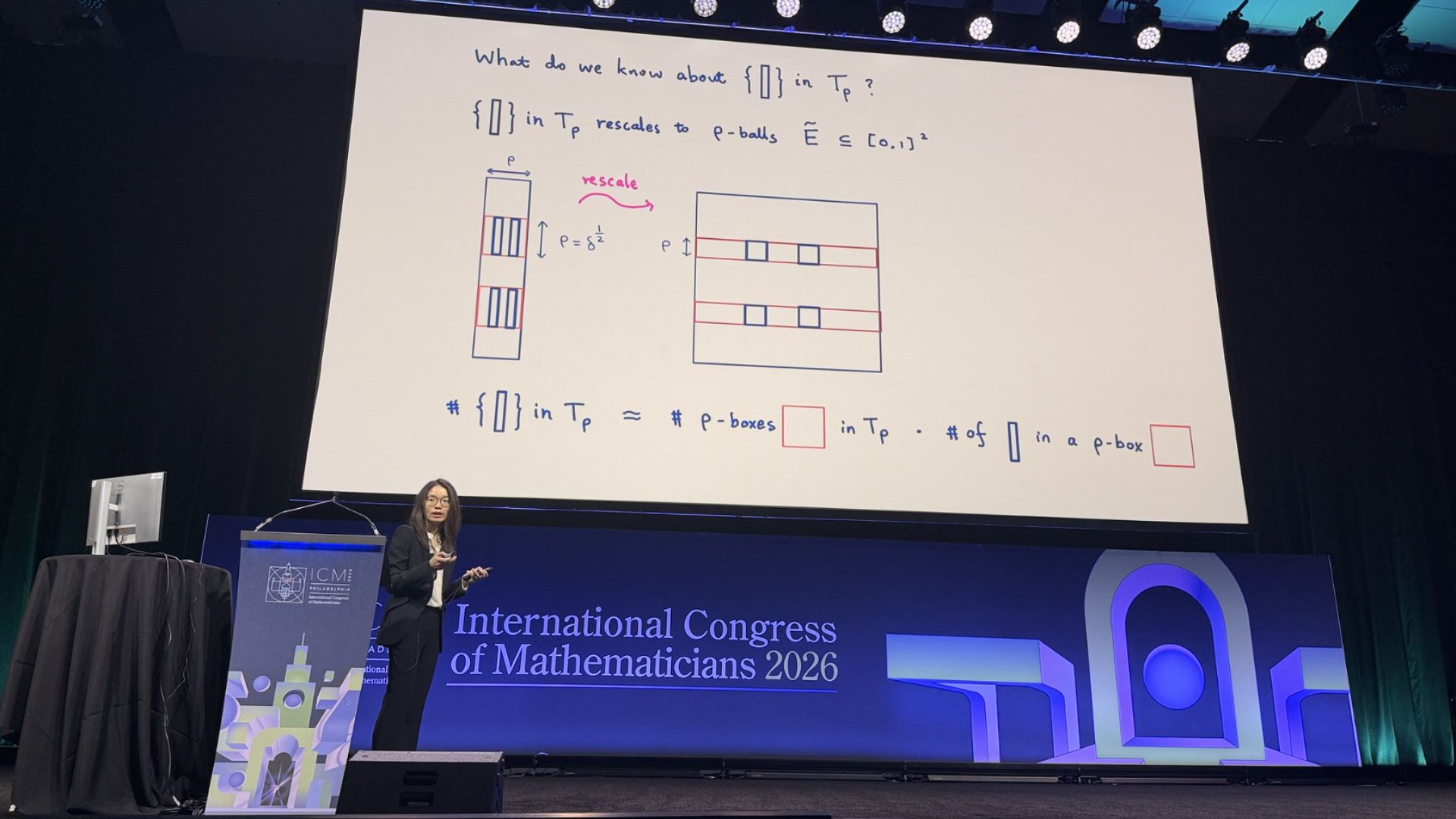
The problem can be approached through a deceptively simple image: how small can a set be if it must contain a needle pointing in every possible direction? The question developed into a major problem connecting harmonic analysis, geometric measure theory and other areas of mathematics.
Wang and Zahl proved that a Kakeya set in three-dimensional space must have full dimension three. Their result grew out of decades of work on the problem by mathematicians including Jean Bourgain, Thomas Wolff, Nets Katz, Terence Tao and others.
Zahl was a doctoral student of 2006 Fields Medalist Terence Tao. In June 2025, he joined the Chern Institute of Mathematics at Nankai University in China as a chair professor.
In her Fields Medal lecture in Philadelphia, Wang placed the Kakeya problem within a broader discussion of projections of fractal sets, Furstenberg sets and the relationships among these geometric questions.
Yu Deng: From Go to Hilbert’s Sixth Problem
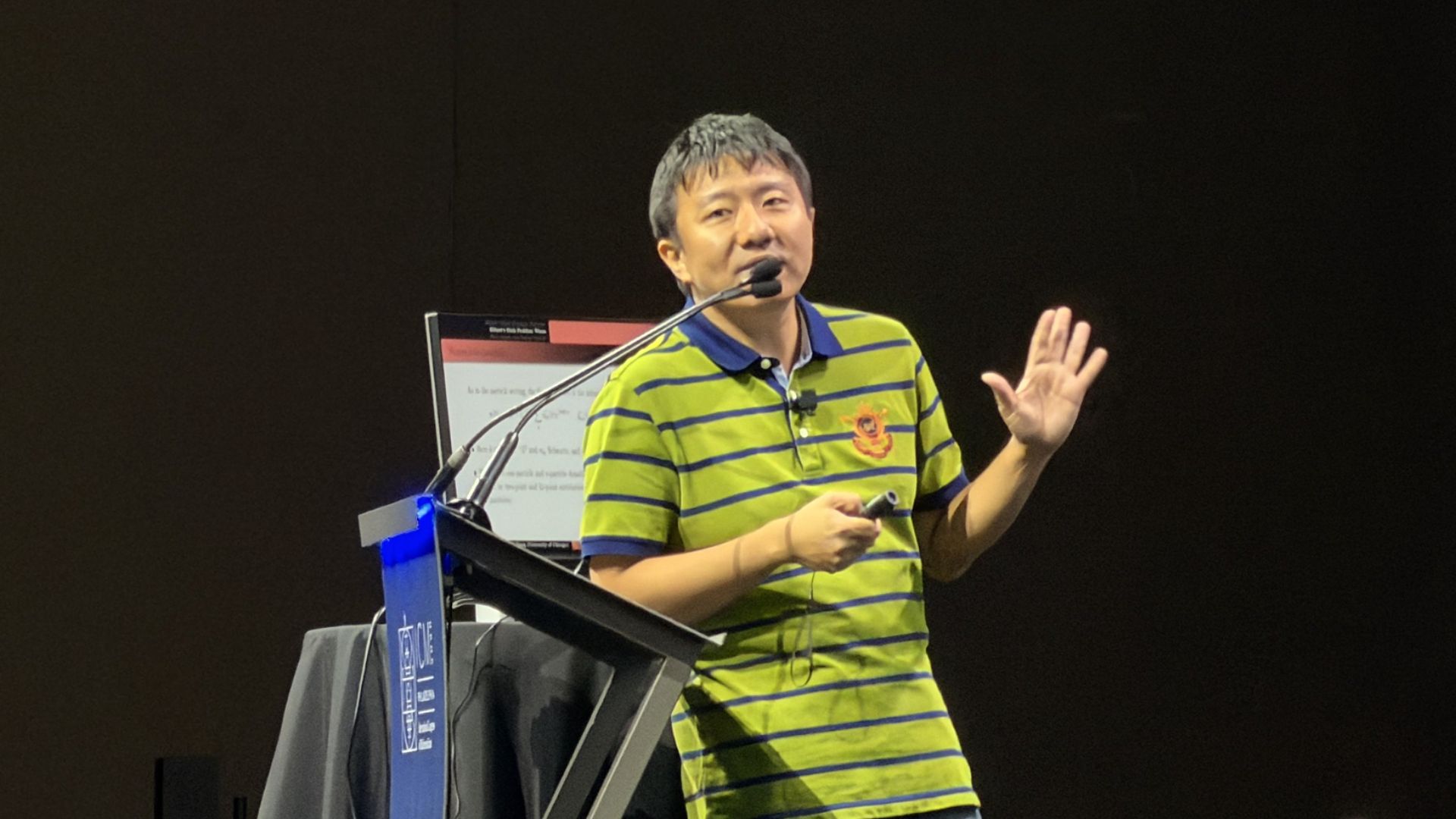
Deng grew up in Shenzhen and studied Go as a child, at one point considering pursuing it professionally. He later turned toward mathematics competitions and won a gold medal at the 2006 International Mathematical Olympiad.
His research now focuses on partial differential equations and their connections with probability.
One way to understand the problem he studies is to imagine collisions. Tracking a handful of billiard balls is straightforward. But what happens when there are trillions of microscopic particles constantly colliding? How can the motion of individual particles lead rigorously to a statistical description of a gas — and eventually to the macroscopic behavior of fluids?
That question belongs to a much larger research program associated with the sixth problem David Hilbert presented in 1900.
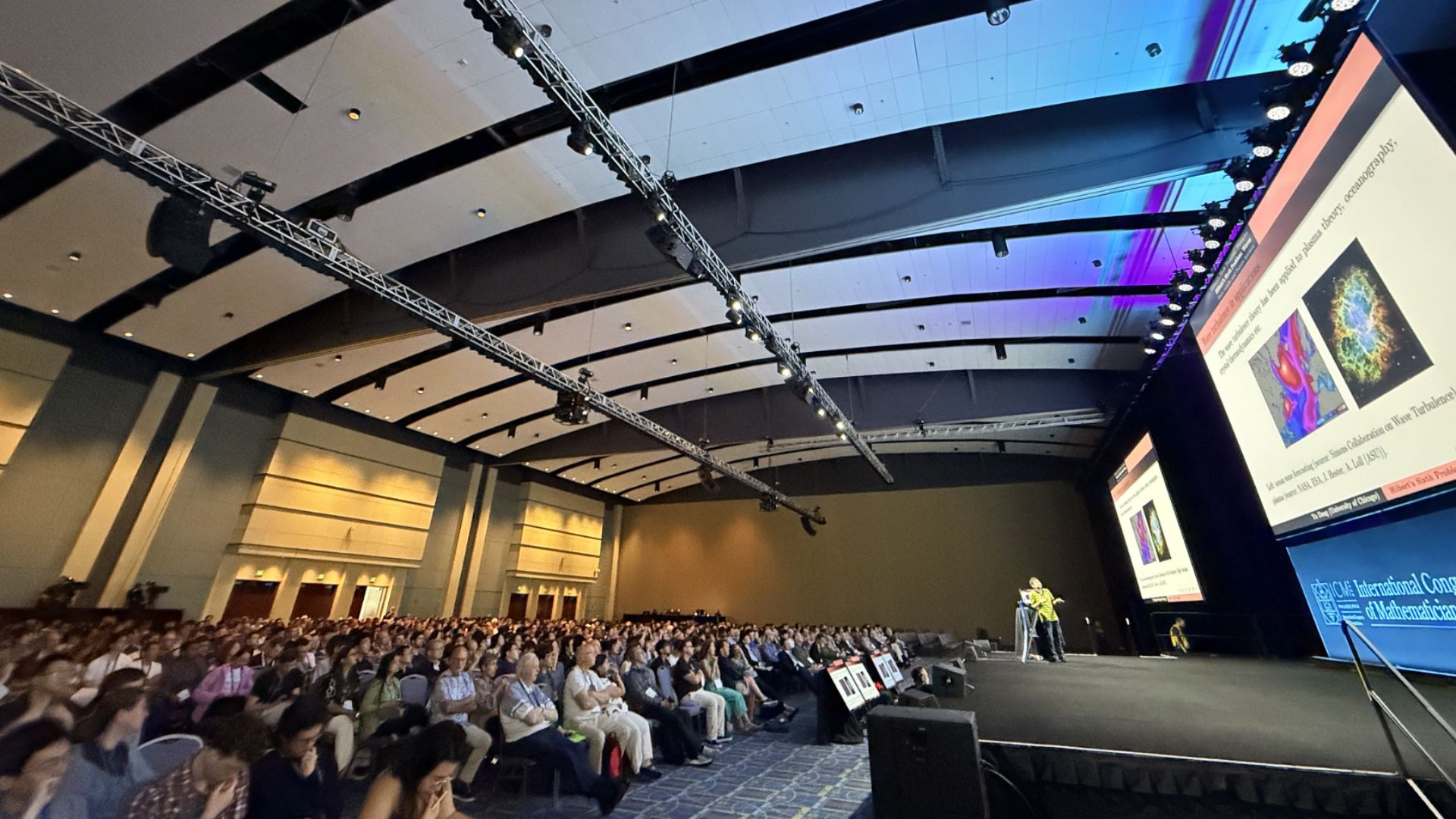
Deng’s work also emerged through sustained collaboration. He worked with Zaher Hani on wave turbulence and related kinetic problems, and Xiao Ma later joined their research. Together, they developed methods for organizing enormous histories of particle interactions into multilayer structures that could be mathematically analyzed, pushing key derivations beyond earlier short-time restrictions to arbitrarily long finite times under the relevant assumptions.
In his Fields Medal lecture, Deng traced the path from microscopic particle dynamics to the Boltzmann equation and then toward macroscopic fluid equations, while also explaining a parallel program involving waves and wave kinetic equations.
“When Will This Happen at Chinese Universities?”
The fact that two mathematicians who grew up and received their early education in China won Fields Medals at the same ICM also produced a direct question at the medalists’ press conference.
German journalist Christoph Drösser asked Wang and Deng about the development of mathematics in China. With increasing numbers of mathematicians being trained there, he asked, when might more researchers go to Chinese universities and conduct groundbreaking work there?
Deng was cautious. He said Chinese universities had been improving and that mathematicians based at Chinese institutions were already producing very good work. He could not predict when an achievement of the kind described in the question would emerge from a Chinese institution, he said, but “the trend is clear.”
Wang answered more directly.
“I think it’s already happening.”
She said mathematicians in China were already doing excellent work and noted that many of her collaborators had moved to or were now based in China. One example was Zahl — her collaborator on the three-dimensional Kakeya conjecture — who had joined Nankai University full time.
A Xinhua News Agency reporter later put a related question to Nakajima, asking about the achievements of the two medalists with Chinese educational backgrounds and the development of mathematics in China.
Nakajima brought the answer back to the Fields Medal selection process.
“The quick answer is that we don’t care,” he said, before clarifying what he meant: as chair of the Fields Medal Committee, “we never consider their nationalities” when discussing the mathematical accomplishments of candidates.
The committee evaluates the mathematics.
Beyond Mathematics: Mitsumi, Mahjong and Bourgain
At the press conference, the medalists were also asked whether they had mathematical heroes.
Wang and Deng independently named the same mathematician: Jean Bourgain.
Deng said he never really had the opportunity to know Bourgain but had spent years reading his papers, describing the work as exceptionally deep — and exceptionally difficult to read.
Wang also named Bourgain, comparing some of the mathematical tools he developed to something that could save you during a difficult hike.
Outside mathematics, both also have interests that offer a glimpse of a different side of their lives.
Wang has long used Mitsumi Iwakura, the protagonist of the Japanese manga and anime Skip and Loafer, as a social-media avatar. Mitsumi leaves a small rural community to attend high school in Tokyo and dreams of eventually entering public service and becoming a mayor so she can help improve her hometown.
Deng has also long been interested in Japanese anime, as well as novels, Go and puzzles. Among the series he has publicly shown an affinity for is Saki, whose story centers heavily on competitive mahjong.
On July 23 in Philadelphia, Wang and Deng — mathematicians who grew up in Guilin and Shenzhen and later built their careers across an international network of universities, mentors and collaborators — received two of the four Fields Medals awarded at ICM 2026.
More from ICM 2026
VisibleTogether will continue their coverage of the 2026 International Congress of Mathematicians, including an exclusive interview with IMU President and 2026 Fields Medal Committee Chair Hiraku Nakajima; an interview with incoming IMU President Ulrike Tillmann; and reporting on artificial intelligence and mathematics at ICM 2026.