[VT | July 22, 2026 | Washington D.C.]
From protein structure prediction to mathematical proofs, X-ray imaging, electric-grid simulation, and the design and manufacturing of flight-test vehicles, artificial intelligence is being applied across different stages of scientific research.
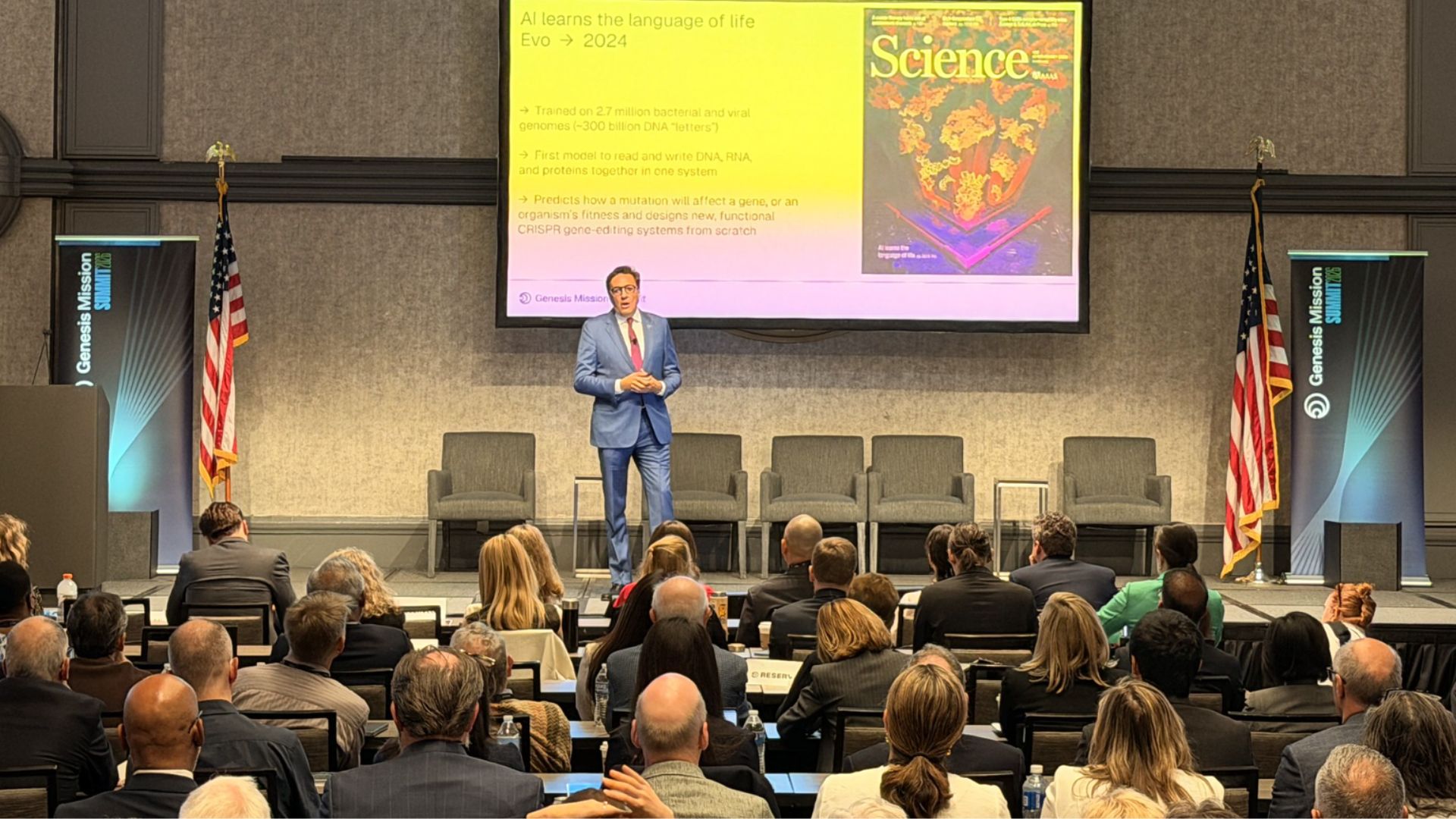
At the Technical Keynote of the inaugural Genesis Mission Annual Summit, Darío Gil, Under Secretary for Science at the U.S. Department of Energy (DOE) and leader of the Genesis Mission, introduced the mission’s AI for Science vision — applying artificial intelligence to scientific research and discovery. Four Science Lightning Talks that followed presented applications of AI in mathematics, advanced imaging, the electric grid, and national security.
From 200,000 Protein Structures to 200 Million
Gil began with protein structure prediction.
In 1971, Brookhaven National Laboratory (BNL) helped establish the Protein Data Bank. For decades, scientists determined three-dimensional protein structures through experimental methods such as X-ray crystallography, using X-ray diffraction patterns to reconstruct molecular structures. After roughly 50 years of work across the global scientific community, experimentally determined protein structures had grown to about 200,000.
DeepMind’s AlphaFold uses neural networks to predict three-dimensional protein structures from amino acid sequences, expanding the number of available predicted protein structures to roughly 200 million.
Gil then discussed AI applications in genomics. Researchers are using large-scale DNA sequences to train foundation models that learn biological patterns across species. He cited training data on the scale of approximately 9 trillion base pairs across 128,000 species.
Mathematics: From “Proof Scarcity” to “Proof Abundance”
Terence Tao, Professor at the University of California, Los Angeles (UCLA) and a Fields Medalist, discussed AI applications in mathematical research, including problem solving, code generation, automated formalization of proofs, and literature search. In some tasks, he said, researchers are seeing improvements of tenfold or even a hundredfold.
Tao also discussed a collection of roughly 1,200 significant mathematical problems from the 20th century. About a year ago, roughly 300 had been solved; that number is now approaching 500. He observed that releases of new AI models have been accompanied by noticeable changes in progress on the list.
An AI system producing an answer does not necessarily mean the answer is correct. Tao therefore discussed the growing role of formal verification: AI can generate candidate proofs, while formal systems can check whether the logical steps in those proofs hold.
Tao described the change using two terms: “proof scarcity” and “proof abundance.”
Mathematics has traditionally faced the difficulty of finding proofs. As AI systems become capable of generating more candidate proofs, verification, selection, and the choice of research questions become corresponding parts of the research process.
X-Ray Imaging: Accelerating Experimental Data Processing
Laurent Chapon, Associate Laboratory Director for Photon Sciences at Argonne National Laboratory (ANL), presented applications of AI in advanced X-ray imaging.
Large light-source and neutron facilities operated by U.S. national laboratories can be used to examine the internal structure of materials, including reconstructing complex three-dimensional circuitry inside semiconductor chips without destroying the sample. The instruments first produce complex diffraction data, which must be computationally reconstructed into three-dimensional images.
Chapon said facilities of this kind can generate data volumes equivalent to roughly 150 million movies per year. An experiment may take minutes or hours, while data processing and image reconstruction can take days or weeks.
Chapon showed AI models being used for image reconstruction. As X-rays scan a sample, the models can accelerate the conversion of detector data into three-dimensional images, bringing some processes that previously took hours or days closer to real time. In related tasks, he said, the improvement can reach at least 100-fold.
Researchers can therefore view reconstructed results while an experiment is still underway and use those results to adjust experimental conditions and subsequent observations.
The Electric Grid: Evaluating Millions of Possible Scenarios
Hendrik Hamann, Chief AI Scientist for Innovation, Science and Security at Brookhaven National Laboratory (BNL), presented applications of AI in electric-grid research.
Hamann described the U.S. electric grid as having roughly 200 million access points, 50 million transformers, 10 million energy resources, and 7 million miles of wires. Electricity demand, generation, weather, storage, and distributed energy resources are changing simultaneously and interacting across the system.
Grid operations and planning involve multiple time horizons, including balancing electricity in real time, anticipating demand hours or days ahead, and determining how new generation, data centers, and other major loads can connect years into the future.
Traditional physics-based models can simulate the grid, but as the number of variables increases, the number of possible scenarios can reach into the billions, while actual planning can calculate only a fraction of them.
Hamann described a grid foundation model being developed for the Genesis Mission that learns relationships among grid topology, demand, and power flows to evaluate large numbers of possible scenarios more quickly. In some tasks, he said, the model has achieved improvements of up to 1,000 times and can evaluate millions of scenarios. A data-center interconnection study that might previously have taken months or years can be substantially shortened.
National Security: From Design to Manufacturing and Flight Testing
Sivasankaran Rajamanickam, Distinguished Member of the Technical Staff at Sandia National Laboratories (SNL), presented an application of AI across design, manufacturing, and physical testing.
His team has been working on a flight-test vehicle for high-speed research. Such vehicles must withstand complex thermal, vibration, and structural loads, and their development involves multiple stages including design, simulation, manufacturing, sensor integration, and testing.
The team combined AI-driven topology optimization with advanced manufacturing, scientific software, data, and high-performance computing. Given engineering objectives and constraints, the system explored different structural options. Rajamanickam showed 16 candidate designs, from which the research team selected one for manufacturing.
Advanced manufacturing was then used to turn the digital design into a physical object, followed by validation through sensors and physical testing. The team also used AI in payload and sensor-layout design.
Rajamanickam said the project moved from requirements to its first production unit in approximately three months, and to its first flight test in approximately eight months.
AI Across Scientific Workflows
The Technical Keynote presented AI applications across different stages of scientific research.
Tao discussed AI-assisted mathematical problem solving, proof generation, and formal verification. Chapon showed AI being used to process X-ray data from major scientific facilities and accelerate three-dimensional image reconstruction. Hamann presented a grid foundation model for evaluating large numbers of electric-grid scenarios. Rajamanickam showed AI being used across engineering design, advanced manufacturing, and physical testing.
Together with Gil’s examples of protein structure prediction and genomic foundation models, the presentations documented AI applications across prediction, computation, data processing, simulation, design, manufacturing, and verification.
—
VisibleTogether reported from the inaugural Genesis Mission Annual Summit in Washington, D.C., on July 22, 2026.