[VT | June 4, 2026 | Washington D.C.]
Not Just an AI Announcement — A New Scientific Alliance
The United States and Japan announced a $1 billion strategic scientific partnership under President Trump’s Genesis Mission, making Japan the first international partner in what U.S. officials describe as a long-term effort to transform how scientific research is conducted in the age of artificial intelligence.
The agreement commits both nations to invest $500 million each over five years and brings together twelve U.S. Department of Energy National Laboratories, one DOE User Facility, and twelve leading Japanese research institutions.
Rather than focusing on consumer AI applications, the initiative centers on scientific infrastructure — combining AI systems, supercomputing, research data, national laboratories, and advanced scientific facilities into a shared discovery ecosystem.
Why This Matters
For decades, scientific collaboration between the United States and Japan has existed through individual research projects and institutional partnerships.
The Genesis Mission represents something larger:
a coordinated framework linking government agencies, national laboratories, universities, industry partners, computing infrastructure, and research programs across both countries.
According to DOE Under Secretary for Science and Genesis Mission Director Dr. Darío Gil, the mission aims to double the productivity and impact of American science and engineering within a decade by leveraging advances in AI, high-performance computing, semiconductors, and quantum technologies.
AI as Scientific Infrastructure
One of the most notable themes throughout the announcement was the repeated emphasis on AI as infrastructure rather than simply as a software product.
Officials described a future research environment where:
- AI models
- National laboratories
- Scientific datasets
- Supercomputers
- Quantum systems
- Autonomous laboratories
operate together as an integrated scientific platform.
This vision reflects a broader shift occurring globally as governments increasingly view AI as a foundational research capability comparable to previous generations of scientific infrastructure.
Key Institutions
United States:
- U.S. Department of Energy (DOE)
- DOE National Laboratories
- DOE Office of Science User Facilities
Japan:
Fugaku-related computational science programs
RIKEN
University of Tokyo
National Institute for Materials Science (NIMS)
KEK
J-PARC
Key Figures
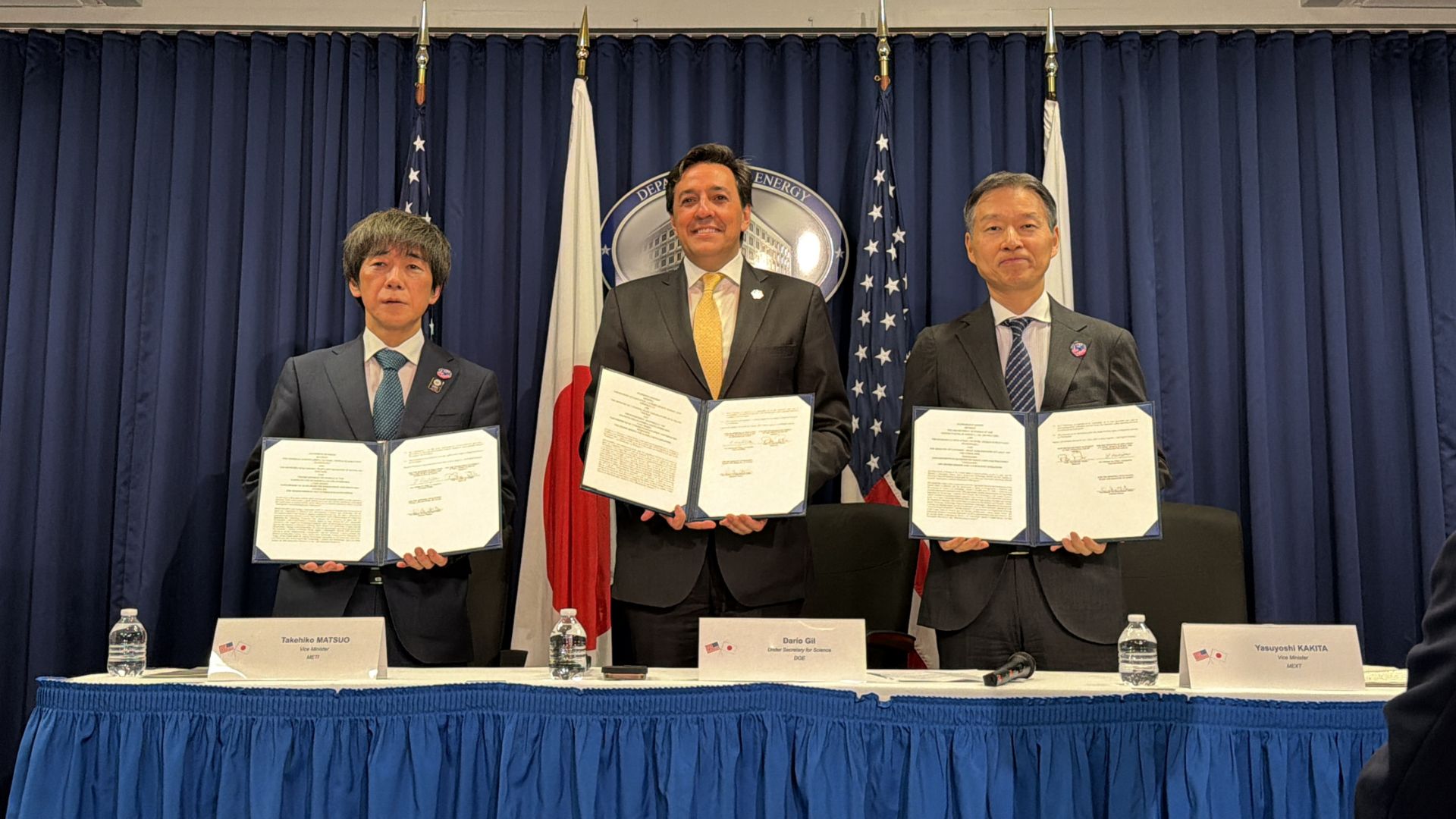
The announcement was led by:
- Dr. Darío Gil, U.S. Department of Energy Under Secretary for Science and Genesis Mission Lead
- Dr. Yasuyoshi Kakita, Vice-Minister for Policy Coordination, MEXT
- Mr. Takehiko Matsuo, Vice Minister for International Affairs, METI
All three officials emphasized the strategic importance of AI, advanced computing, and long-term U.S.–Japan scientific cooperation.
Beyond Research: A New Technology Alignment
The partnership also builds upon the U.S.–Japan Technology Prosperity Deal signed in 2025 and reflects a broader effort to align scientific, industrial, and technological capabilities between the two countries.
Throughout the discussion, officials referenced semiconductors, AI infrastructure, supply chain resilience, and next-generation computing as strategic priorities for both nations.
The Genesis Mission therefore represents not only a scientific collaboration, but also an emerging model for how democratic allies may organize research infrastructure and technological development in the AI era.