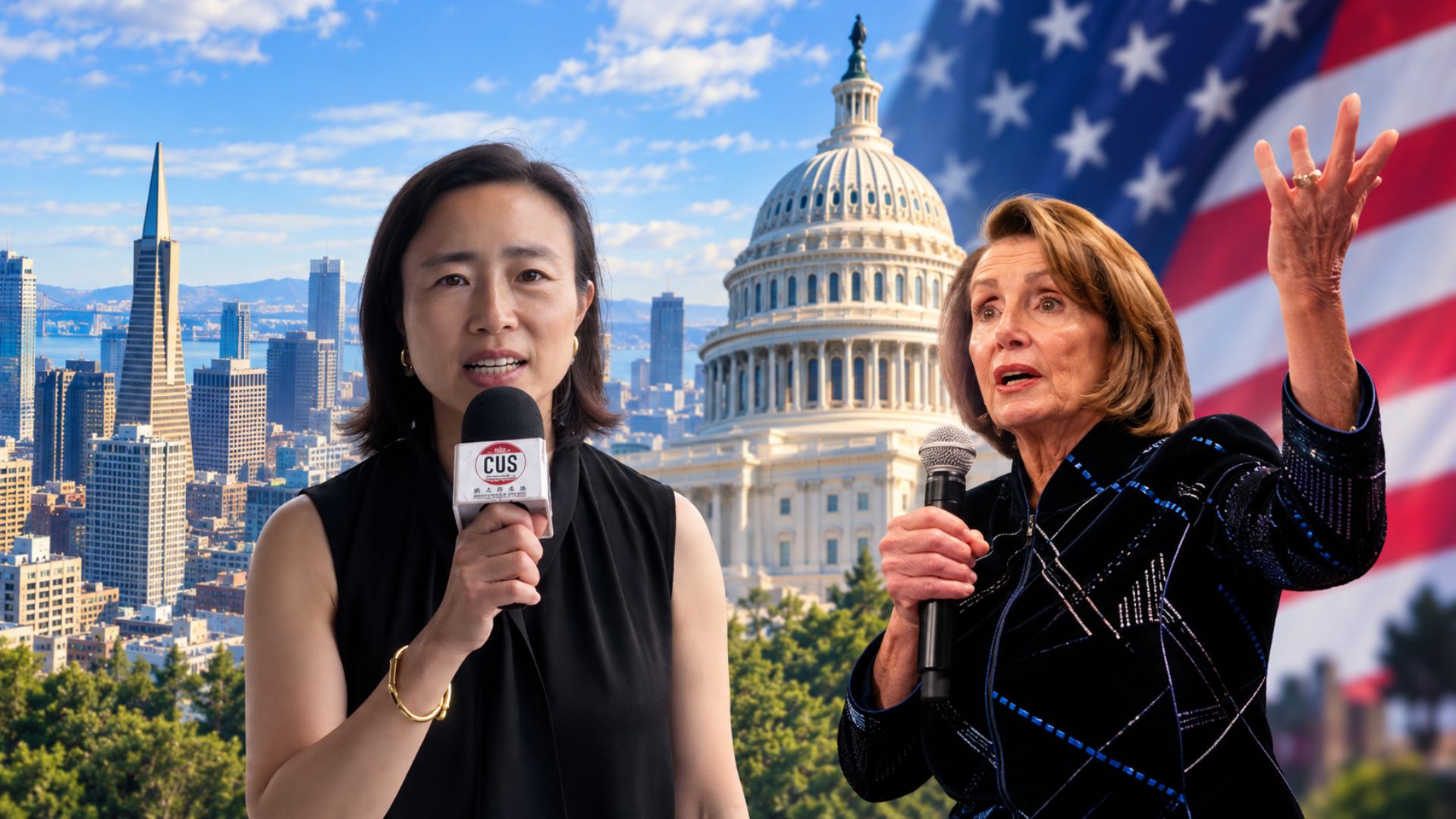
Left: San Francisco Supervisor and congressional candidate Connie Chan during an exclusive interview with VisibleTogether (VT) in Philadelphia on September 18, 2026. Right: Former U.S. House Speaker Nancy Pelosi at the Democratic National Committee (DNC) Winter Meeting in Philadelphia in February 2023. Both images are original VT footage and photography, composited for this article’s cover.
[VT | October 24, 2026 | Philadelphia, PA]
How the race to succeed Nancy Pelosi became a test of what a member of Congress can bring home — and why Asian American political networks are part of the answer.
On Nov. 3, voters in California’s 11th Congressional District will choose who replaces Rep. Nancy Pelosi, who has represented San Francisco since 1987. The contest between two Democrats — San Francisco Supervisor Connie Chan and state Sen. Scott Wiener — has tightened since the June primary.
Most coverage has asked whether Pelosi’s endorsement can carry Chan to victory. This analysis asks a different question: after Pelosi, what kind of representative does San Francisco need — and how does a member of Congress turn a political network into public resources the district can actually use?
The race
In the June 2 top-two primary, Wiener took 40.7% of the vote and Chan 29.7%, according to the certified results — a gap of 25,917 votes. Saikat Chakrabarti, a former chief of staff to Rep. Alexandria Ocasio-Cortez who clashed publicly with Pelosi in 2019, finished third with 42,060 votes, then threw his support and field operation behind Chan.
Pelosi moved earlier. She endorsed Chan in May, hosted a fundraiser for her in July, and in August her communications director, Ian Krager, took leave from her office to join Chan’s campaign. Two camps that once stood on opposite sides of Democratic politics now back the same candidate.
A USC Democracy and Fair Elections Lab poll of 454 likely voters, conducted Oct. 16–19 in five languages including Chinese, found Wiener at 47%, Chan at 41% and 9% undecided, with a margin of error of ±4.6 points. Among voters who approve of Pelosi, Wiener held a narrow edge within the margin of error.
Who Connie Chan is
Chan was born in Hong Kong, attended elementary school in Taiwan, and immigrated to San Francisco at 13 with her mother and younger brother. The family lived in a rent-controlled one-bedroom apartment on the edge of Chinatown. Her mother took English and computer classes at City College, processed insurance claims at Chinese Hospital, and later worked as a social worker at On Lok, serving Chinese-speaking seniors.
After Galileo High School and UC Davis, Chan worked as a volunteer interpreter and community organizer, then spent two decades in city government — as a spokesperson for several departments and as an aide to Supervisor Sophie Maxwell, then-District Attorney Kamala Harris and Supervisor Aaron Peskin. Elected in 2020 to represent District 1, which includes the heavily Chinese American Richmond District, she was re-elected in 2024 by 1,301 votes and went on to chair the Board of Supervisors’ Budget and Appropriations Committee, overseeing a city budget of roughly $17 billion. If elected, she would be the first Chinese American and Asian American to represent San Francisco in Congress.
In her words: language access, media and resources
In an interview with VisibleTogether in Philadelphia on Sept. 18, Chan was asked about government language access: when federal agencies launch programs and distribute funding, how do residents who read Chinese learn about them?
Chan said that while serving San Francisco’s Chinese community she saw new immigrants miss out on services because of language barriers, which is why the city requires services in Chinese and Spanish. In Congress, she said, she would push for the same approach “when we provide grant opportunities to our community” — information that is “not only coming in English” but “multilingual, inclusive of Chinese and Spanish.”
She also tied representation to media coverage and data:
“When we want to make sure that our government services reflect our population, we see that it lacks data, it lacks media coverage… This is what happened when community organized and gain power and elect people that can represent us, so that we can actually have media coverage. We can have data in the government and, most importantly, resources and funding that we can bring back.”
She connected her City Hall budget work to what she would do in Washington: “Managing a $17 billion budget in San Francisco really helped me understand what we need to do and make sure that the federal government’s budget also reflect our values and serve our community.”
Her stated federal priorities include health care, affordable child care, fully funded K–12 education and immigration reform with a pathway to citizenship.
Why a congressional network matters
A supervisor writes city ordinances and a city budget. A state senator writes state law and a state budget. A member of Congress works on federal law and federal spending — and very little of that moves alone. Bills need co-sponsors; appropriations need allies on the committees that write them.
San Francisco has seen what that leverage can produce. In October 2012, with Pelosi serving as House Democratic leader, the Federal Transit Administration committed $942.2 million to the Central Subway, a project then estimated at about $1.6 billion that extends Muni’s T Third line to Chinatown. The money came from years of federal, state and city work, but federal dollars on that scale depend on a district’s voice in Washington — and they shape a neighborhood’s transit, commerce and development for decades.
Two networks, two levels of government
Both candidates have federal endorsers. The difference is where each network is concentrated. The figures below are as listed on each campaign’s endorsement page at publication.
| Connie Chan | Scott Wiener | |
|---|---|---|
| U.S. senators | 1: Adam Schiff | None |
| Current U.S. House members | 12, including Speaker Emerita Nancy Pelosi | 9 |
| Committee and caucus roles among House endorsers | Grace Meng (CAPAC chair; ranking member, Appropriations subcommittee on Commerce, Justice, Science); Judy Chu (Ways and Means; former CAPAC chair); Zoe Lofgren (ranking member, Science); Jared Huffman (ranking member, Natural Resources); Norma Torres (Appropriations); Pramila Jayapal (former Progressive Caucus chair) | Robert Garcia (ranking member, Oversight); Josh Harder (Appropriations); Jerry Nadler (former Judiciary chair, retiring in January) |
| Statewide California officials | None | Attorney General Rob Bonta; Treasurer Fiona Ma |
| State legislative leaders | None | Senate President pro Tem Monique Limón; Assembly Speaker Robert Rivas; 20 other legislators |
Chan’s network sits largely in Washington. It runs through the Congressional Asian Pacific American Caucus, whose 79 members work with the Congressional Black and Hispanic caucuses as the Tri-Caucus, and through ASPIRE PAC, founded by Asian American members of Congress, which endorsed her in November 2025. Its current chair, Rep. Marilyn Strickland, and former chairs Chu and Meng have each endorsed her individually.
Wiener’s network sits largely in Sacramento, where nearly a decade in the state Senate produced a long record on housing, transit and LGBTQ rights and state funding he has highlighted for Chinese Hospital and Portsmouth Square. He also led the primary in votes and fundraising.
What transfers, and what does not
Pelosi can hand a successor relationships: donors, staff, labor allies and colleagues willing to take a call. She is already using them for Chan. She cannot hand over her seniority, the authority she held as speaker, or her standing inside the Democratic caucus. Whoever wins will arrive as a freshman.
The network also has a direction. The San Francisco Standard, citing people familiar with the matter, has reported years of strain between Wiener and Pelosi’s circle; Pelosi has said publicly only, “I’m not here to talk about him.” If Wiener wins, Pelosi’s network will not automatically stand behind him. If Chan wins, she arrives with that network already behind her.
Endorsements describe relationships, not results. They do not guarantee committee assignments, co-sponsors or appropriations. And this analysis does not address other issues that have defined much of the race’s coverage, including housing policy and the candidates’ differing positions on Israel and Gaza.
Promises are easy to make on the campaign trail. Delivering them in Washington takes votes, co-sponsors and allies on the committees that control the money — and a new member does not build those overnight. That is the question San Francisco voters are really answering on Nov. 3: which candidate is better positioned to turn a network in Washington into the next Central Subway — federal investment the district can see and use.