[VT | September 28, 2026 | NewYork NY]
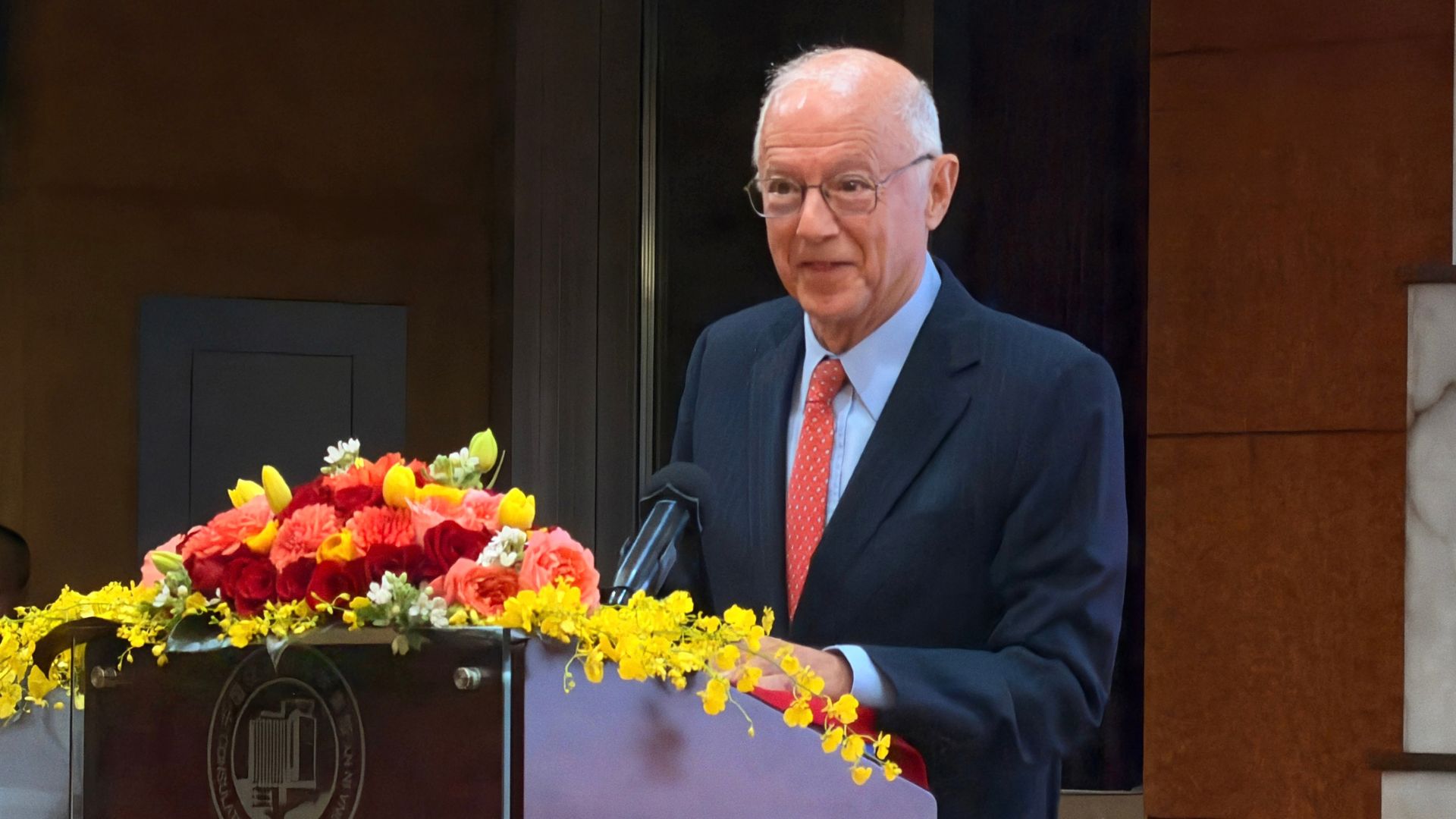
Stephen A. Orlins, president of the National Committee on U.S.-China Relations (NCUSCR), looked back on nearly five decades of U.S.-China engagement at a September 28 reception hosted by the Chinese Consulate General in New York, weeks before he is scheduled to step down.
The reception marked the 77th anniversary of the founding of the People’s Republic of China, three days after Chinese President Xi Jinping concluded a state visit to Washington. Orlins welcomed the two presidents’ expressions of cooperation, then turned to how the relationship looked when he first worked on it.
From 1976 to 1979, Orlins served in the Office of the Legal Adviser at the U.S. State Department, where he was part of the legal team involved in establishing diplomatic relations with Beijing. He recalled that the internal memoranda of that period framed normalization largely in terms of the Soviet Union.
“There was no discussion of the economic relationship,” he said.
That relationship later became a central part of U.S.-China engagement, and a central part of Orlins’ own career. After leaving the State Department, he practiced law and moved into international finance and investment, holding senior positions at Lehman Brothers, AEA Investors, and Carlyle Asia. In 2005, he became president of NCUSCR, an independent nonprofit founded in 1966 to encourage understanding and exchange between the two countries.
Presidents can set the direction of U.S.-China relations. Turning that direction into lasting results involves a much wider range of people and institutions.
That work takes place in federal agencies and congressional offices, state and local governments, universities, research institutions, and industries including energy, biotechnology, and artificial intelligence. Each operates under different responsibilities and constraints. Congress exercises its own legislative and oversight authority, while universities and businesses make decisions according to their own missions and obligations. Not all of this work follows from summit agreements, and agreements reached at the highest level do not resolve every question that follows.
Orlins’ career has moved through several parts of that landscape. NCUSCR’s programs occupy another. They include Track II dialogues bringing together policy specialists from both countries, exchanges with members of Congress and congressional staff, and CHINA Town Hall, a public education program connecting national discussions with local audiences across the United States.
Such programs do not replace official diplomacy or the responsibilities of elected officials. They provide settings in which people from different institutions can exchange information, examine disagreements, and maintain contact between presidential meetings.
As NCUSCR prepares to mark its 60th anniversary, Orlins is concluding more than two decades as president. Sarah Beran, a former career diplomat who joined the committee in October, is scheduled to succeed him on November 10. During 23 years in the Foreign Service, she served as deputy chief of mission at the U.S. Embassy in Beijing and held senior positions at the White House National Security Council and the State Department.
Orlins said his desire to work for what is good for the American and Chinese people had not changed since he first arrived in China in 1979.
“I will maintain that commitment after I step down,” Orlins told the reception.
Since the memoranda of the late 1970s, the institutions involved in the relationship have changed, and so have the issues. Summits continue to draw the world’s attention. Between them, the relationship is also shaped by people whose work rarely appears in the photographs.