[VT | March 27, 2026 | Online]
More than half of Asian Americans regularly experience assumptions that they are foreign, according to new national survey findings released by the Committee of 100.
But one of the study’s more striking findings is who experiences those assumptions.
Being born in the United States appears to make little difference.
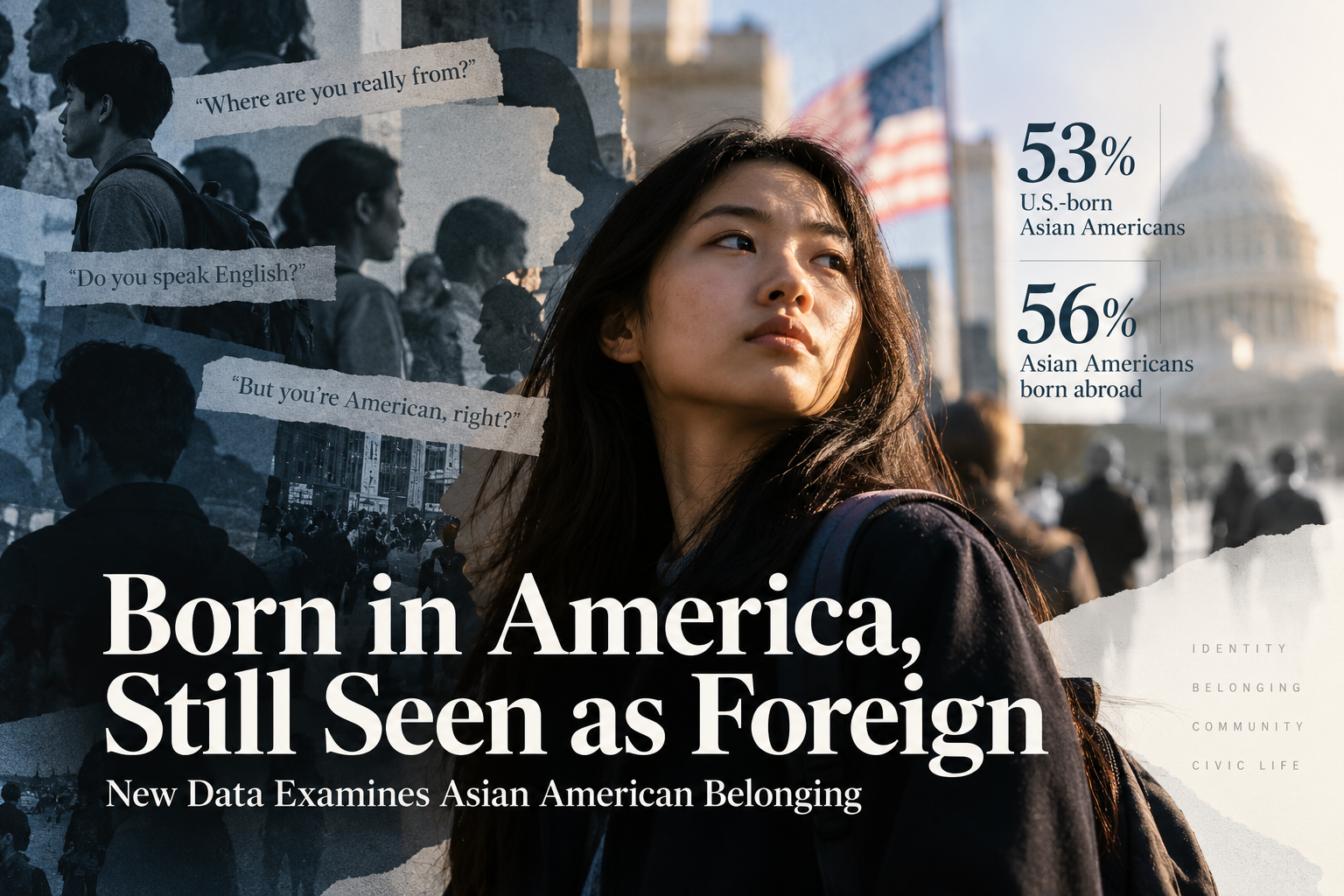
The study found that 53 percent of U.S.-born Asian Americans regularly experienced assumptions of foreignness, compared with 56 percent of Asian Americans born abroad.
The findings were presented March 25 during a Committee of 100 webinar formally launching the second report from its 2025 State of Chinese Americans Survey. The survey was conducted in June 2025 through NORC at the University of Chicago’s Amplify AAPI and AmeriSpeak panels and included about 2,021 participants.
The report examines what researchers describe as the “perpetual foreigner” stereotype — the assumption that Asian Americans are somehow from somewhere else, regardless of where they were born or how long their families have lived in the United States.
Birthplace changes little
The survey measured two related but distinct experiences.
Overall, 54 percent of Asian Americans surveyed reported experiencing some form of race- or ethnicity-based everyday discrimination in a given month.
Separately, 55 percent reported the most commonly identified form of exclusion in the survey: assumptions of foreignness, such as being asked where they were “really” from or being assumed not to speak English.
Researchers found that this pattern differed from what they observed among some other racial and ethnic groups. For Asian Americans, rates of being perceived as foreign remained similar regardless of whether a person was born inside or outside the United States.
That distinction matters because nativity would ordinarily seem to provide a straightforward answer to whether someone is “from” the United States.
For many Asian Americans in the survey, it did not.
Teresa Hsu, founder and executive director of Supportive Place for Empowering Asian Americans and Kin, described the problem during the discussion.
“You can prove intelligence, you can prove abilities,” Hsu said. “But you can also say, ‘Hey, I was born in Georgia.’ And you can still get the question, ‘But where are you really from?’”
From foreignness to belonging
The study also examined what happens when those encounters are repeated.
Among U.S.-born Asian Americans, researchers found that regularly experiencing assumptions of foreignness was associated with a substantially weaker sense of belonging in the United States. Those reporting such experiences were about three times as likely to say they did not feel that they belonged.
The same experiences were also associated with higher levels of psychological distress, including measures related to anxiety, depression, sadness and feelings of worthlessness.
Vivien Leung, an assistant professor of political science at Santa Clara University who presented the findings, said the experience can carry different meanings for U.S.-born and foreign-born Asian Americans.
Leung said questions about foreignness may be less jarring for someone born outside the United States because they can correspond to an actual migration history. For U.S.-born Asian Americans, she said, the same assumption can undercut a life experience rooted entirely in the United States.
The study does not suggest that foreign-born Asian Americans avoid such experiences. Their reported rate was slightly higher. Rather, the researchers found that similar treatment can carry different implications depending on a person’s experience and relationship to the country.
When belonging reaches civic life
The discussion also moved beyond individual encounters.
Leung connected a weaker sense of belonging with a broader body of political-science research on civic participation. If people repeatedly receive signals that they are outsiders, she said, that experience can affect whether they feel that political institutions and public life are places in which they have a meaningful role.
During the presentation, Leung cited turnout and representation as two areas where Asian Americans continue to lag behind their share of the population. She also described a potential feedback loop: lower participation can mean less outreach from candidates and political institutions, which can in turn reinforce disengagement.
The researchers presented these relationships as part of a larger cycle of exclusion rather than as evidence that any single discriminatory encounter directly determines whether someone votes or participates in politics.
That distinction is important. The survey measures experiences and associations across a broad and diverse Asian American population. It does not mean that all Asian Americans experience foreignness in the same way, or that belonging alone explains differences in political participation.
A longer history of who is seen as American
Panelists placed the findings within a longer U.S. history in which Asian Americans have periodically faced questions about citizenship, loyalty and belonging.
The discussion referenced the Chinese Exclusion Act, the incarceration of Japanese Americans during World War II, treatment of Muslim and South Asian communities after September 11, and anti-Asian rhetoric during the COVID-19 pandemic. Panelists also pointed to more recent scrutiny of Chinese scientists.
The circumstances differ substantially across those periods. The connection raised by the panel was the recurring question of who is presumed to belong — and who can be treated as foreign based on race or perceived national origin.
Panelists also discussed possible responses, including greater outreach by policymakers, culturally responsive mental-health services, stronger teaching of Asian American history in schools and greater Asian American participation in civic spaces.
Leung argued that representation in classrooms and public institutions can matter because people encounter ideas about who belongs not only through direct discrimination, but also through what they see — or do not see — in the country’s history and civic life.
The findings do not resolve the broader question of Asian American belonging in the United States. They do identify one striking feature of it.
For U.S.-born Asian Americans, birthplace alone does not necessarily settle the question of whether others see them as belonging.
Editor’s note: This article is based on reporting and materials from the Committee of 100’s March 25, 2026 webinar, including the researchers’ presentation of the study’s methodology, and the accompanying report. It is published here as part of VisibleTogether’s archive. The data and characterizations reflect the record available at that time.