[VT | July 22, 2026 | Washington D.C.]
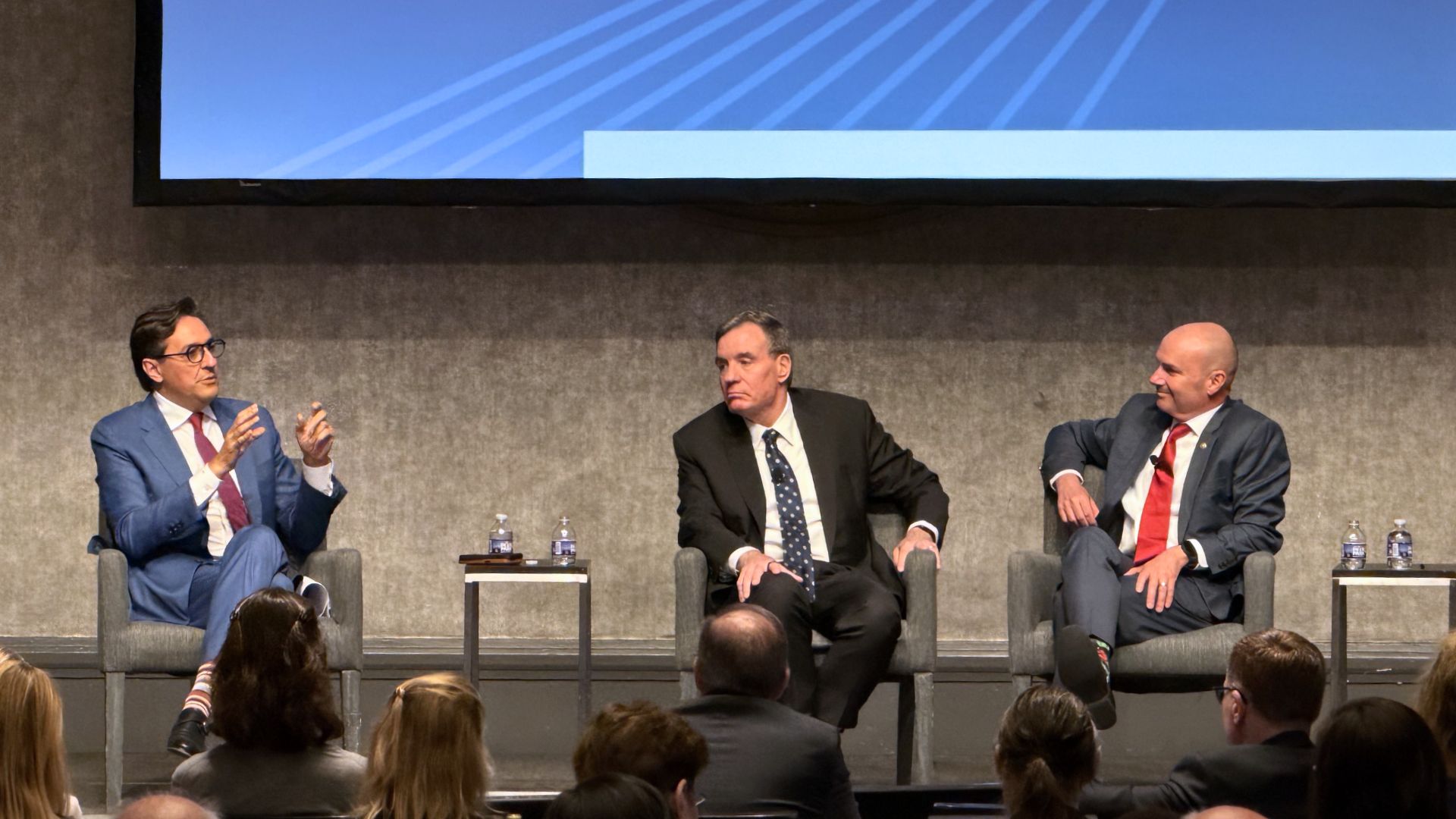
Darío Gil, U.S. Department of Energy (DOE) Under Secretary for Science and lead of the Genesis Mission, moderated the summit’s “Congressional Perspectives” discussion with Republican U.S. Senator Mike Lee of Utah and Democratic U.S. Senator Mark Warner of Virginia. The discussion covered U.S. science and innovation, research talent, legislation for the Genesis Mission, artificial intelligence, employment, national security and energy.
Mike Lee: Government, Science and Innovation
Lee began with the role of the federal government in science and innovation.
He discussed constitutional powers involving patents, copyrights, national defense, interstate and international commerce, arguing that government is not itself responsible for producing scientific discoveries but can establish institutional and resource frameworks within its responsibilities that allow innovation to occur.
Lee also connected the Genesis Mission to the effectiveness of federal research and development investment. He said the United States should not compete technologically by imitating China’s “command and control economy,” but should instead use its own institutions and innovation system to make more effective use of resources already invested in science and technology.
Mark Warner: More U.S.-Trained Ph.D. Talent
Warner approached the discussion through scientific talent.
He pointed to the role of the 1958 National Defense Education Act in developing U.S. science, engineering and national-security talent. He said the United States has long benefited from attracting talented researchers from around the world through immigration, while also needing to train more U.S. doctoral talent.
Warner described a legislative effort to provide greater support for U.S. doctoral students and create accelerated pathways for some students from undergraduate study through a Ph.D., bringing the full educational path to roughly seven years rather than requiring a longer graduate and doctoral sequence after completing a bachelor’s degree.
Gil added historical context on the National Defense Education Act. He noted that it was enacted in 1958 following the Soviet launch of Sputnik and said the number of U.S. science and engineering Ph.D.s subsequently grew at roughly 10 percent annually over the following decade. He asked whether the current environment calls for a new effort comparable to the National Defense Education Act, including educational incentives, student support and summer internships.
Genesis Mission and Congressional Legislation
Gil then turned the discussion directly to the Genesis Mission.
He said the mission is designed on a ten-year or longer horizon and that Congress needs to be a partner, asking Lee about putting Genesis into law.
Lee referenced a Saturday Night Live parody of the classic Schoolhouse Rock! educational segment while discussing the difference between executive orders and legislation passed by Congress. He described executive orders as potentially “easy come, easy go,” and said:
“This mission, while created by executive order, needs to be propelled through legislation.”
Lee said laws can also be repealed, but repealing a law is more difficult than a president changing an executive order. He said the Genesis Mission needs a statutory foundation if it is to have a lasting role. Lee said at the summit that he was working on legislation, but did not announce a specific Genesis bill introduced by him.
Warner also supported a longer-term institutional foundation for Genesis. At the same time, he said the mission should not come at the expense of traditional research funding sources such as the National Science Foundation (NSF) and National Institutes of Health (NIH), and raised issues including peer-based review and keeping political ideology from interfering with science.
Two Related Bills: H.R. 6360 and S. 5187
The congressional discussions around a longer-term foundation for the Genesis Mission and the development of U.S. scientific talent also have related legislative efforts in Congress.
H.R. 6360, the “GENESIS Act.” Republican U.S. Representative Mike Kennedy of Utah introduced the bill on December 2, 2025. The legislation concerns giving legal effect to Executive Order 14363, which launched the Genesis Mission, and was referred to the House Committee on Science, Space, and Technology. Kennedy was not part of the “Congressional Perspectives” discussion at the summit. H.R. 6360 was also not a bill announced by Lee during the discussion, and Lee did not connect his remarks to H.R. 6360.
S. 5187, the “Promoting High-skilled Doctoral (PHD) Talent Act of 2026.” Warner’s bill relates directly to the doctoral-training issue he discussed at the summit. It includes a DOE pilot program supporting universities in developing accelerated undergraduate-to-Ph.D. pathways and strengthening training partnerships among universities, national laboratories and industry. Republican U.S. Senator Todd Young of Indiana joined the legislative effort.
AI and National Security
Gil then asked Warner about AI and quantum technologies in the context of national security.
Warner, Vice Chairman of the Senate Select Committee on Intelligence, expressed support for using AI to accelerate scientific innovation while also discussing AI governance, market competition, safety testing and emerging questions surrounding AI agents.
Warner said he believed that even leaders in AI could be underestimating the speed of technological change. At the same time, he argued against a simple “pedal to the metal” approach without safeguards.
On AI agents, he raised questions about competition among different agents, control by platforms and what responsibilities those systems have toward users. He also discussed testing and safety mechanisms before the release of more capable AI systems.
AI and Employment
Warner then turned to employment.
He said he expects AI to create new jobs over the long term, but anticipates significant short-term employment disruption over the next five years, with recent college graduates among the groups of particular concern.
Warner said the effects may not primarily appear as companies announcing large layoffs, but instead as reduced hiring. He cited law firms and customer-service jobs as examples of areas where positions that have traditionally served as entry points for college graduates could be affected first.
He also discussed university education and workforce preparation. Warner said that several years ago, when asked what people should learn for the AI era, many might have answered basic coding. He said that answer has already changed and that the United States needs to reconsider which skills should be developed for the future. He also pointed to continued demand for professionals including doctors, nurses and physical therapists.
Lee responded from the history of technological change, discussing how electricity, the steam engine, biomedicine and pharmaceuticals changed work while also producing new occupations and industries.
Lee acknowledged that AI could replace some existing work, but said it could also increase what people are capable of doing. He cited drug development and the legal profession, saying AI can expand the range of candidates examined in early-stage drug research, while lawyers can use AI for some tasks but still need to ask the right questions, use the tools and perform real-world legal work.
Warner added that his concern was not that AI would fail to create jobs in the long term, but the potential gap between rapid technological change and the emergence of new work.
Energy
Toward the end of the discussion, Gil asked each senator to identify a problem they wanted the scientists in the room to help solve.
Lee focused on energy. He said AI, quantum computing, data centers and future scientific and industrial development will require large amounts of reliable electricity, and discussed nuclear energy, fusion and geothermal energy as sources capable of providing continuous baseload power.
Warner agreed on the importance of energy and put it more directly:
“It’s not going to be who has the most scientists, who has the most chips. It’s going to be who has the most electrons.”
He also discussed small modular reactors (SMRs) and a planned commercial fusion demonstration project in Chesapeake, Virginia.
“Make These Tools Improve People’s Lives”
Warner ended by turning to the practical use of AI.
He described an effort involving OpenAI and Anthropic to use AI agents to help active-duty military families and veterans in Virginia’s Hampton Roads region connect with existing services. The region has many available services, he said, but individuals can have difficulty finding and accessing the resources relevant to them.
Warner then turned to researchers from the first 278 projects selected for the Genesis Mission. He noted that more than 5,000 applications had been submitted and 278 teams were ultimately selected.
His final message to the researchers was:
“Don’t screw it up.”
The “Congressional Perspectives” discussion then concluded.
—
VisibleTogether reported from the inaugural Genesis Mission Annual Summit in Washington, D.C., on July 22, 2026.