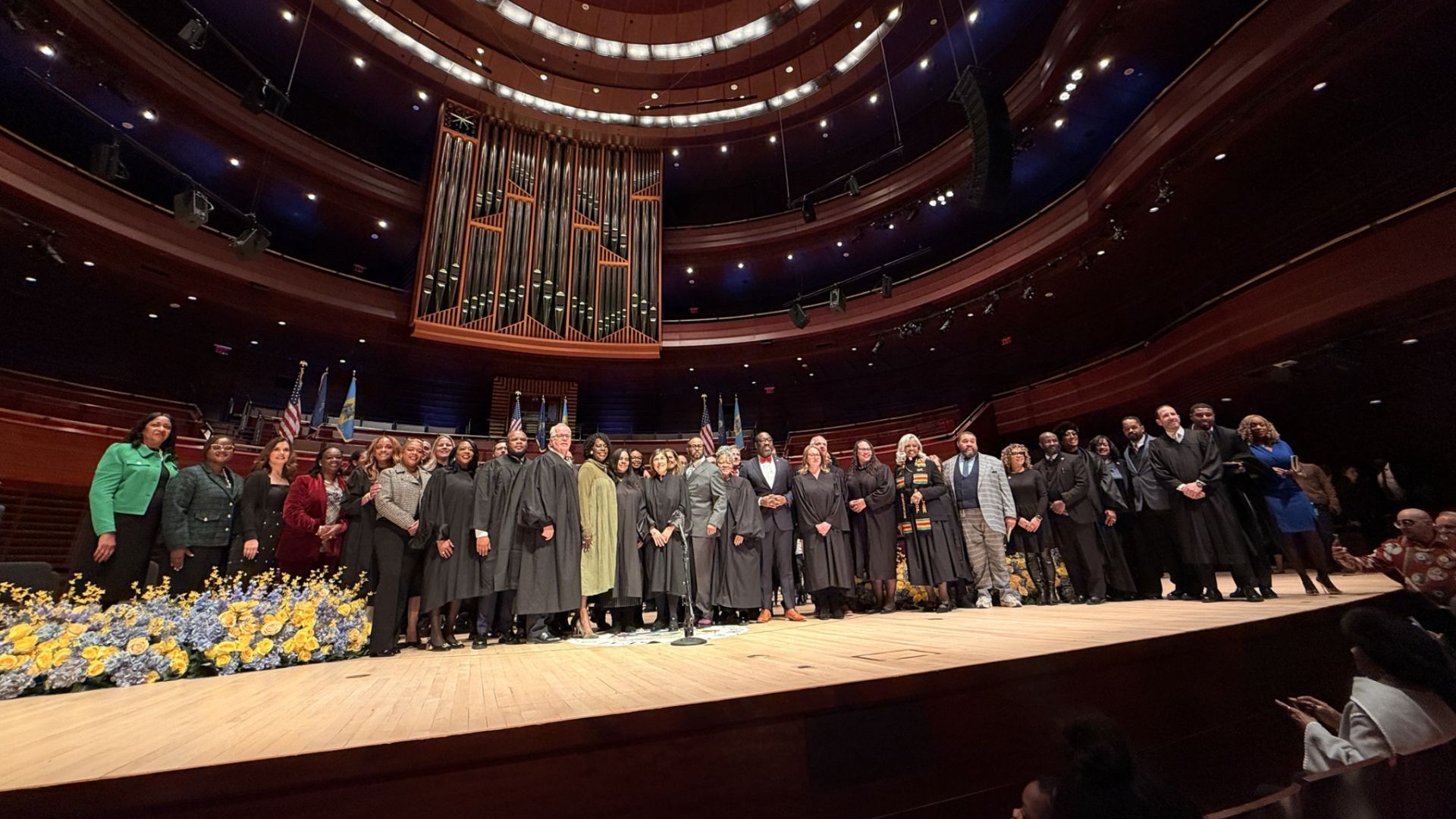
[VT – Philadelphia, PA January 5, 2026 ] The City of Philadelphia marked the official start of a new civic and judicial term on Monday with a formal inauguration ceremony at the Kimmel Center for the Performing Arts, Marian Anderson Hall. The event celebrated the swearing-in of District Attorney Larry Krasner to a third term, City Controller Christy Brady to her first full term, and 34 newly elected and retention judges of the Court of Common Pleas and Municipal Court.
The ceremony, emceed by City Representative and Director of Special Events Jazelle Jones, drew city leaders, members of the judiciary, clergy, community representatives, and residents to what officials framed as both a continuation of service and a fresh chapter for Philadelphia’s justice and financial oversight systems.
34 Judges Take the Oath of Office
President Judge Nina Wright Padilla of the Philadelphia Court of Common Pleas administered the oath of office to newly elected and retention judges of the Court of Common Pleas, while President Judge T. Francis Shields did the same for Municipal Court judges. Judges stood with their Bible holders, raised their right hands, and pledged to “support, obey, and defend the Constitution of the United States and the Constitution of this Commonwealth” and to discharge the duties of their offices “with fidelity.”
Those sworn in included:
Newly Elected Judges, Court of Common Pleas
- Hon. Will Braveman
- Hon. Irina Ehrlich
- Hon. Lawrence M. Farnese Jr.
- Hon. Kia Ghee
- Hon. Sarah Jones
- Hon. Leon A. King II
- Hon. Brian Kisielewski
- Hon. Joseph J. Russo
- Hon. Jennifer A. Santiago
- Hon. Anthony Stefanski
- Hon. Deborah Watson-Stokes
Retention Judges, Court of Common Pleas
- Hon. Ann M. Butchart
- Hon. Scott DiClaudio
- Hon. Michael Fanning
- Hon. Daine A. Grey Jr.
- Hon. Christopher Mallios
- Hon. Walter J. Olszewski
- Hon. Frank Palumbo
- Hon. Rainy Papademetriou
- Hon. Tracy Roman
- Hon. Stephanie M. Sawyer
- Hon. Susan I. Schulman
- Hon. Michael H. Wojcik
- Hon. Lyris F. Younge
- Hon. Gwendolyn N. Bright
Newly Elected Municipal Court Judges
- Hon. Sherrie Cohen
- Hon. Amanda Davidson
- Hon. Michael Parkinson
- Hon. Cortez Patton
Retention Judges, Municipal Court
- Hon. David H. Conroy
- Hon. Jacquelyn Frazier-Lyde
- Hon. Henry Lewandowski
- Hon. Wendy L. Pew
- Hon. T. Francis Shields
President Judge Padilla and President Judge Shields both emphasized that the judiciary’s responsibilities extend beyond legal procedure, underscoring the obligation to administer justice fairly, impartially, and without bias.
Mayor Parker: Historic Crime Decline and “One Philly” Collaboration
Mayor Cherelle L. Parker praised the cooperation between city government, law enforcement, and the courts, crediting intergovernmental collaboration for historic public safety gains.
Referencing 2025 crime data, Parker noted that homicides and shootings in Philadelphia had fallen to their lowest level in roughly 50 years. She framed the city’s approach as a three-part public safety strategy—“prevention, intervention, and enforcement”—and stressed that meaningful progress requires coordination among the Police Department, the Office of Public Safety, the District Attorney’s Office, victim advocates, and the judiciary.
Parker congratulated City Controller Christy Brady on her election and commended her for focusing on the work, rather than politics, in her role as the city’s fiscal watchdog. She also congratulated District Attorney Larry Krasner on his reelection to a third term, observing that “the people of our city have elected you three times now,” which she said signaled public support for his efforts to balance prosecution and reform.
The mayor thanked judges for their role in innovative initiatives such as neighborhood wellness courts, particularly in neighborhoods like Kensington, describing these efforts as part of a broader “One Philly, a united city” vision.
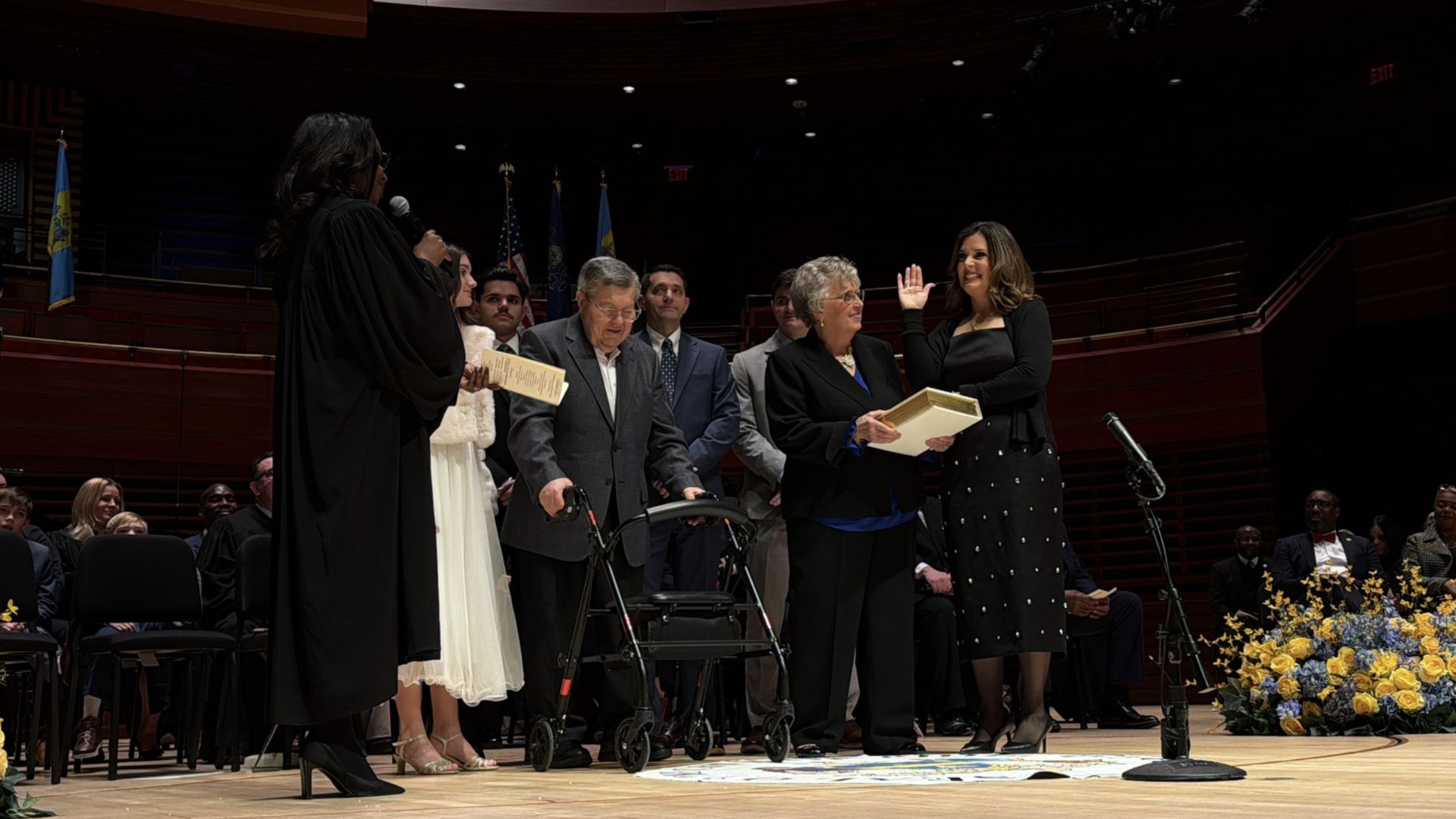
Controller Christy Brady: “No Waste, Fraud or Abuse on My Watch”
Philadelphia City Controller Christy Brady was introduced by Judge Natasha Taylor Smith and sworn in to her first full four-year term. Brady, who previously completed the remainder of her predecessor’s term, has spent her career in the Controller’s Office and called the role a serious public trust.
In her remarks, Brady highlighted recent accomplishments by her office, including:
- Strengthening building inspection oversight to ensure safe construction and neighborhood safety.
- Uncovering misuse of the city’s real estate tax relief program so that benefits are limited to eligible Philadelphia homeowners.
- Recommending improvements to the School District of Philadelphia’s defenses against cyber fraud to protect public education funds.
Looking ahead, Brady said she will expand oversight of the city’s housing programs to ensure “every dollar borrowed is used as intended and properly accounted for.” She also cited plans to:
- Examine how to maximize the economic impact of Philadelphia’s waterfront and port assets.
- Conduct a comprehensive review of Philadelphia Gas Works operations, balancing environmental responsibility with affordable rates.
- Work with City Council on pension and retirement benefit structures to protect city workers’ futures and keep the pension fund on track for full funding by 2033.
With the United States’ 250th anniversary putting Philadelphia in the national spotlight, Brady noted that the city will see a significant influx of taxpayer dollars for celebrations and infrastructure. “The city must be accountable for every dollar coming in and every dollar going out,” she said, promising to “check the receipts” and declaring, “There will be no waste, fraud, or abuse on my watch.”
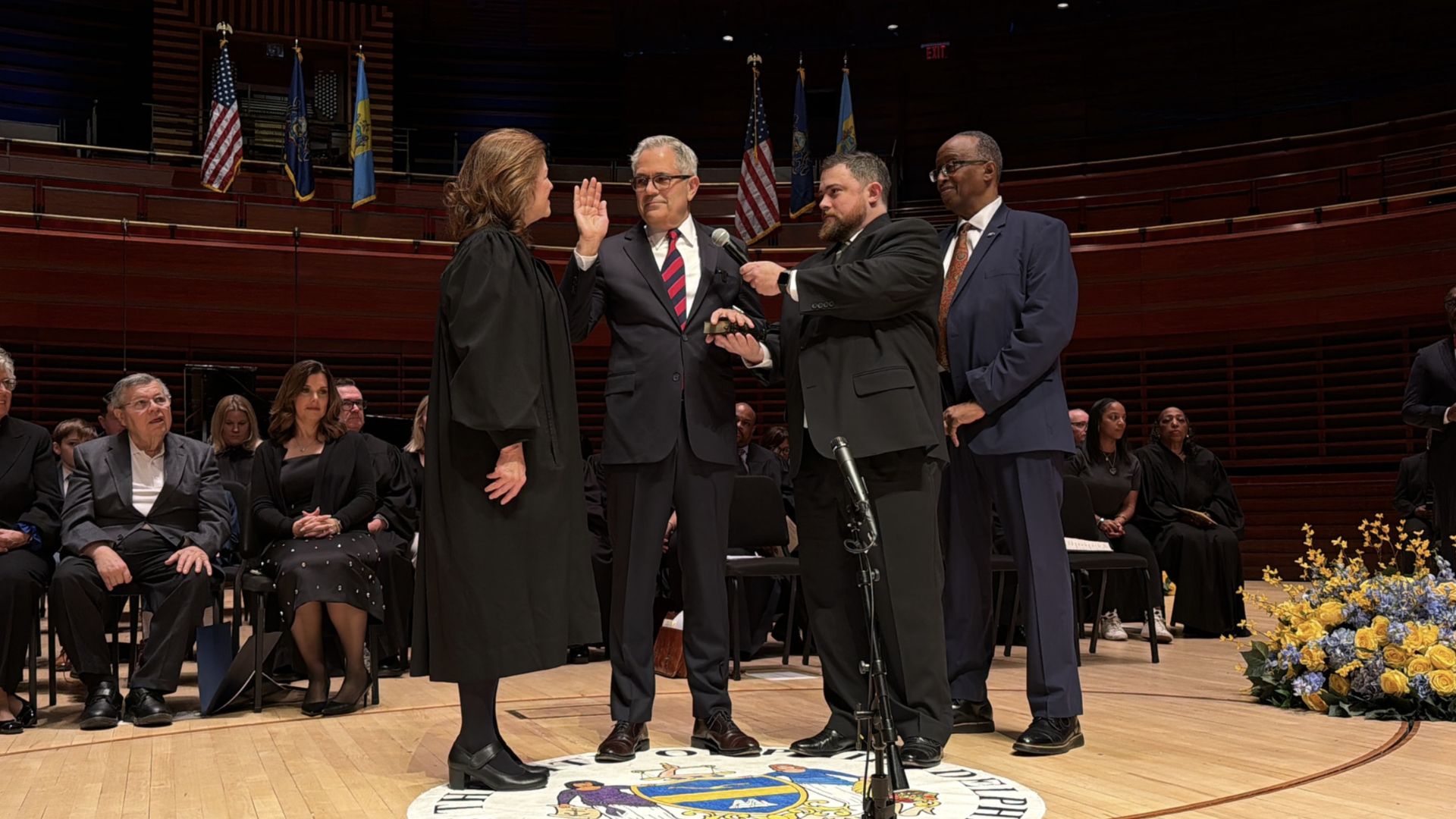
Krasner Sworn In to Third Term: Safety and Freedom Together
First Assistant District Attorney Robert Listenbee introduced District Attorney Larry Krasner, praising Krasner’s leadership during a period when gun violence initially spiked and then sharply declined. Listenbee recalled that homicides peaked at 562 in 2021 but had fallen to 222 by the end of 2025, calling it clear progress while acknowledging that “the loss of one life to homicide may traumatize a family, friends, and a community for a lifetime.”
Listenbee highlighted three main priorities of Krasner’s second term:
- Protecting Constitutional Rights – Ensuring victims’ voices are heard, fairly prosecuting cases involving law enforcement and public officials, and pursuing exonerations for wrongfully convicted individuals.
- Aggressive, Cooperative Crime-Fighting – Working with the Mayor’s Office, City Council, state legislators, the Police Department, and others to reduce murders, shootings, carjackings, and gang violence, including strategic use of forensics such as DNA and cell phone location data.
- Prevention and Reform – Expanding diversion and restorative justice programs, supporting community-based nonprofits through microgrants funded by seized drug proceeds, and advancing bail and sentencing policies that reduce incarceration where appropriate while protecting public safety.
After being sworn in, Krasner thanked his family, office staff, and city officials and reflected on his decades as a trial lawyer, saying the only thing he misses in his current role is trying cases in court.
He invoked the 1925–1926 “Sweet trials” in Detroit—where Black physician Dr. Ossian Sweet’s family was prosecuted after defending their home from a white mob—to illustrate how fear and prejudice have historically distorted the justice system. Krasner quoted defense attorney Clarence Darrow’s argument that “take the hatred away, and you have nothing left,” framing it as a warning against allowing hatred and fear to drive public policy today.
Krasner noted that Philadelphia is now 51 consecutive months into a downward trend in crime, attributing that progress to “excellent collaboration” among city agencies, federal partners, legislators, and community-based organizations. He pointed out that while homicides and shootings have fallen, the number of Philadelphians returning home from state and county custody has increased dramatically, arguing that a safer city does not require mass incarceration.
He pledged to unveil a detailed third-term agenda later this month, developed with input from staff, community members, and partner organizations. The plan, he said, will aim for “more safety and more freedom at the same time,” so that Philadelphia can move from being known as “chronically violent” to “consistently safe for decades to come.”
Krasner also reiterated his duty, as someone empowered to bring criminal charges, to uphold the Constitution in the face of any threats to democracy, stressing that prosecutorial power cannot ignore efforts to undermine the rule of law.
Prayers, Music, and a Call to Shared Responsibility
The ceremony opened with an invocation by Bishop Millicent Hunter of The Baptist Worship Center, who thanked God for “the peaceful continuity of government” and asked for wisdom, clarity, and compassion for the city’s leaders. She prayed that Philadelphia would be “a city where everyone feels valued and has the opportunity to thrive.”
Singer Paula Holloway delivered a powerful rendition of the national anthem, followed later by the Leviticus Ensemble’s moving performance of “Lift Every Voice and Sing,” often referred to as the Black national anthem.
Rabbi David Kushner of Congregation Beth Solomon described the inauguration as “holy work,” even though it was not held in a house of worship, and compared public officials to the shamash—the servant candle on the Hanukkah menorah that lights the others—saying true leadership enables others to shine. He urged judges to pursue justice that is “both principled and compassionate” and reminded elected officials that their authority is “entrusted, not owned.”
Imam Dr. Quaiser Abdullah, Director of Muslim Engagement in the Mayor’s Office, offered the closing prayer and charge. He explained that in Islamic tradition, justice is a divine command—“not optional, not conditional, and not selective”—and described public office as an amanah, or sacred trust. He asked God to grant Philadelphia’s leaders “wisdom with mercy, firmness with humility, and authority tempered with compassion,” and called on all residents to play a role in building a city where justice is not only proclaimed but “fully lived.”
As the ceremony concluded, officials and judges gathered for a group photo on stage. With the United States’ 250th anniversary celebrations on the horizon and global attention turning toward Philadelphia, city leaders cast the day’s proceedings as both a renewal of oaths and a renewed commitment to accountability, equity, and public service in the years ahead.